Materials Science: Unit IV: Optical Properties of Materials
Optical Absorption, Loss and Gain
Optical Properties of Materials
The photon flux associated with an electromagnetic wave traveling through a semiconductor is denoted by
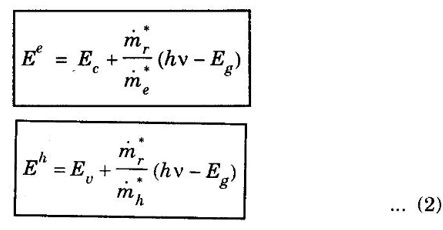
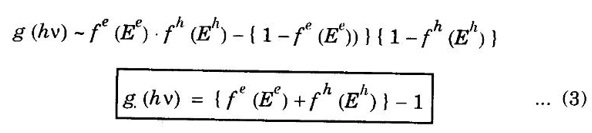
OPTICAL ABSORPTION, LOSS AND GAIN The photon flux associated with an electromagnetic wave traveling through a semiconductor is denoted by where α (the absorption coefficient) is usually positive and I0ph is the incident light intensity at x = 0. The optical intensity (which is the photon flux multiplied by the photon energy h v) falls as the wave travels. The electrons are pumped in the conduction band and holes in the valence band. The electron-hole recombination process (photon emission) can be stronger than electron-hole generation (photon absorption). In general, the gain coefficient is defined by gain coefficient = emission coefficient - absorption coefficient. Let fe (Ee) and fh (Eh) the electron and hole occupation. The emission coefficient depends upon the product of fe (Ee) and fh (Eh). Similarly, the absorption coefficient depends upon the product of (1 − fe (Ee)) and (1- fh (Eh)). Here the energies Ee and Eh are related to the photon energy by the condition of vertical k-transitions. For these transitions we have The occupation probabilities fe and fh are found by the quasi-Fermi levels for electrons and holes. The gain is the difference of the emission and absorption coefficient. It is now proportional to The optical wave has a general spatial intensity dependence: and if g (h v) is positive, the intensity grows because additional photos are added by emission. The condition for positive gain requires "inversion" of the semiconductor system, eqn (3). The quasi-Fermi levels must penetrate their respective bands for this condition to be satisfied.


Materials Science: Unit IV: Optical Properties of Materials : Tag: : Optical Properties of Materials - Optical Absorption, Loss and Gain
Materials Science: Unit IV: Optical Properties of Materials
Under Subject
Materials Science
PH3251 2nd semester Mechanical Dept | 2021 Regulation | 2nd Semester Mechanical Dept 2021 Regulation
Related Subjects
Professional English II
HS3251 2nd Semester 2021 Regulation | 2nd Semester Common to all Dept 2021 Regulation
Statistics and Numerical Methods
MA3251 2nd Semester 2021 Regulation M2 Engineering Mathematics 2 | 2nd Semester Common to all Dept 2021 Regulation
Engineering Graphics
GE3251 eg 2nd semester | 2021 Regulation | 2nd Semester Common to all Dept 2021 Regulation
Physics for Electrical Engineering
PH3202 2nd Semester 2021 Regulation | 2nd Semester EEE Dept 2021 Regulation
Basic Civil and Mechanical Engineering
BE3255 2nd Semester 2021 Regulation | 2nd Semester EEE Dept 2021 Regulation
Electric Circuit Analysis
EE3251 2nd Semester 2021 Regulation | 2nd Semester EEE Dept 2021 Regulation
Physics for Electronics Engineering
PH3254 - Physics II - 2nd Semester - ECE Department - 2021 Regulation | 2nd Semester ECE Dept 2021 Regulation
Electrical and Instrumentation Engineering
BE3254 - 2nd Semester - ECE Dept - 2021 Regulation | 2nd Semester ECE Dept 2021 Regulation
Circuit Analysis
EC3251 - 2nd Semester - ECE Dept - 2021 Regulation | 2nd Semester ECE Dept 2021 Regulation
Materials Science
PH3251 2nd semester Mechanical Dept | 2021 Regulation | 2nd Semester Mechanical Dept 2021 Regulation
Basic Electrical and Electronics Engineering
BE3251 2nd semester Mechanical Dept | 2021 Regulation | 2nd Semester Mechanical Dept 2021 Regulation
Physics for Civil Engineering
PH3201 2021 Regulation | 2nd Semester Civil Dept 2021 Regulation
Basic Electrical, Electronics and Instrumentation Engineering
BE3252 2021 Regulation | 2nd Semester Civil Dept 2021 Regulation
Physics for Information Science
PH3256 2nd Semester CSE Dept | 2021 Regulation | 2nd Semester CSE Dept 2021 Regulation
Basic Electrical and Electronics Engineering
BE3251 2nd Semester CSE Dept 2021 | Regulation | 2nd Semester CSE Dept 2021 Regulation
Programming in C
CS3251 2nd Semester CSE Dept 2021 | Regulation | 2nd Semester CSE Dept 2021 Regulation