Materials Science: Unit IV: Optical Properties of Materials
Light Detectors
Definition, List with Construction, Working Principle
For processing the light signal at the receiver end of the fibre link we require a device to convert the light signals to electrical wave forms.
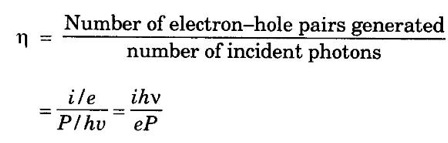
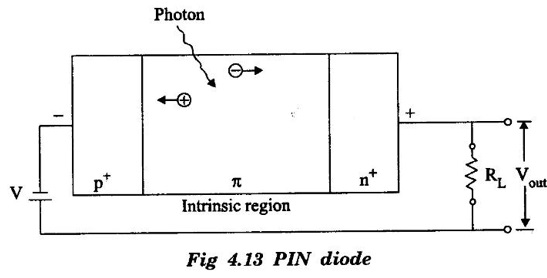
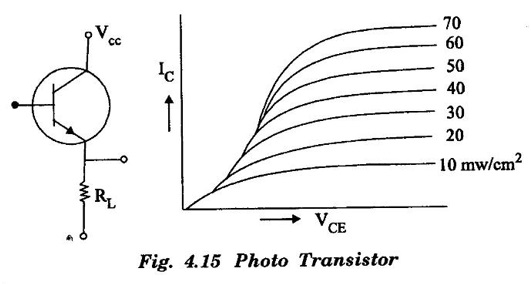
LIGHT DETECTORS For processing the light signal at the receiver end of the fibre link we require a device to convert the light signals to electrical wave forms. This task is done by the photo-detectors. Definition It is a device which converts light signal into electrical wave forms. Types of photo-detectors Photo-detectors are of three types: (i) Photo emissive (ii) Photo conductive (iii) Photo voltaic Photo-Emissive Photo-Detector The emission of electrons from a photo cathode by the incident photon is called photo-emission. Examples of such devices (a) Photo-tubes (b) Photo-multiplier tubes The size of these is normally very large and hence not suitable for use as fibre optic detectors. Photo-Conductive Devices These types of devices have variation of resistance due to incident light on the photo-conductive materials. Example of photo-conductive materials Materials like CdS, Intrinsic semiconductor materials like PIS, PhTe Extrinsic semiconductor like doped Ge and Si They are not suitable for use in fibre optic communication purposes since they have low frequency response. Photo-Voltaic Devices Semiconductor junction photo diodes are called as photo-voltaic devices They are almost ideal for fibre systems. We will study three forms of these devices. 1. PN junction photo detector 2. PIN photo diode 3. Avalanche photo diode (APD) PN junction photo diode as in fig.4.12 explains the basic detection mechanism of a junction detector. When reverse biased, the potential energy barrier between the p and n regions increases. Free electrons (which normally reside in the n region) and free holes (normally in the p region) cannot climb the barrier, so no current flows. The junction refers to the region where the barrier exists. Because there are no free charges in the junction, it is called the depletion region. Figure 4.12 shows an incident photon being absorbed in the junction after passing through the p layer. The absorbed energy raises a bound electron across the bandgap. The quantum efficiency η is defined as the number of electron-bole pairs generated by the number of incident photons, i.e., where, i = photo current developed e = charge on electron P = incident optical power hv = energy of incident photon. The frequency response can be improved if the pn junction is separated by an intrinsic region. The introduction of the intrinsic region decreases the junction capacitance. This is called Positive Intrinsic Negative (PIN) photo diode. (fig 4.13). A PIN diode has an intrinsic semiconductor at the centre and p-type and n-type regions at the end as shown in figure 4.14. It is reverse biased (5 - 20 V). The reverse biasing is used to attract the charge carriers from the intrinsic regions. When light is incident on the PIN diode, the intrinsic region receives more amount of light because of its large size. The photons incident on the intrinsic region produces electron-hole pair. The electron is raised from the valence band to the conduction band, leaving the hole. The electrons are attracted by the reverse biasing and hence move away from the junction. The movement of electrons in the conduction band creates the flow of charge and hence the light energy gets converted into electrical energy. Fig 4.14 explains the working of Avalanche photo-diode. It is much more sensitive than PN or PIN diodes. The avalanche photodiode is based on the principle of avalanche multiplication of the current. It consists of heavily doped p+ and n+ regions. The depletion region is lightly doped, almost intrinsic. The diode is reverse biased using 50-300 V. The light is made to incident on the depletion region. The incident light produces electron and hole pair. The electrons move towards the p region. Due to the strong reverse biasing, there is a depletion of charge carriers in the p region. The electrons in the p region undergo avalanche multiplication because of high reverse bias. The holes move towards the p+ regions without producing further multiplication. The avalanche photodiode has better noise performance, because the carrier multiplication is limited to electrons only. Photo-Transistor is another type of photo detector. A transistor photo diode with its characteristic curves is shown in fig. 4.15.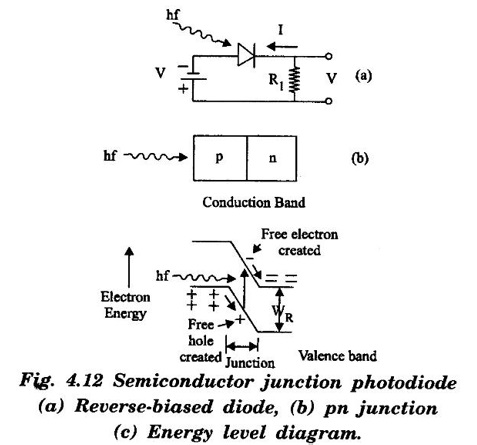
Quantum efficiency
PIN Photo Diode
Avalanche Photo-Diodes (APD)
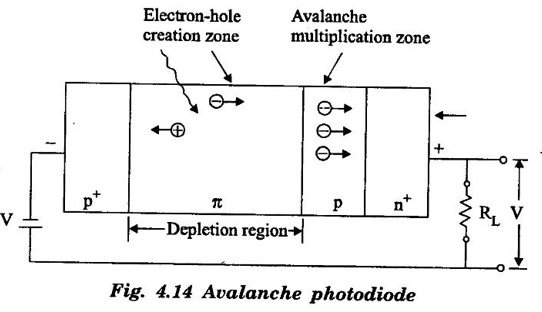
Photo-Transistor
Materials Science: Unit IV: Optical Properties of Materials : Tag: : Definition, List with Construction, Working Principle - Light Detectors
Materials Science: Unit IV: Optical Properties of Materials
Under Subject

Materials Science
PH3251 2nd semester Mechanical Dept | 2021 Regulation | 2nd Semester Mechanical Dept 2021 Regulation
Related Subjects

Professional English II
HS3251 2nd Semester 2021 Regulation | 2nd Semester Common to all Dept 2021 Regulation
Statistics and Numerical Methods
MA3251 2nd Semester 2021 Regulation M2 Engineering Mathematics 2 | 2nd Semester Common to all Dept 2021 Regulation

Engineering Graphics
GE3251 eg 2nd semester | 2021 Regulation | 2nd Semester Common to all Dept 2021 Regulation
Physics for Electrical Engineering
PH3202 2nd Semester 2021 Regulation | 2nd Semester EEE Dept 2021 Regulation

Basic Civil and Mechanical Engineering
BE3255 2nd Semester 2021 Regulation | 2nd Semester EEE Dept 2021 Regulation
Electric Circuit Analysis
EE3251 2nd Semester 2021 Regulation | 2nd Semester EEE Dept 2021 Regulation
Physics for Electronics Engineering
PH3254 - Physics II - 2nd Semester - ECE Department - 2021 Regulation | 2nd Semester ECE Dept 2021 Regulation

Electrical and Instrumentation Engineering
BE3254 - 2nd Semester - ECE Dept - 2021 Regulation | 2nd Semester ECE Dept 2021 Regulation
Circuit Analysis
EC3251 - 2nd Semester - ECE Dept - 2021 Regulation | 2nd Semester ECE Dept 2021 Regulation
Materials Science
PH3251 2nd semester Mechanical Dept | 2021 Regulation | 2nd Semester Mechanical Dept 2021 Regulation

Basic Electrical and Electronics Engineering
BE3251 2nd semester Mechanical Dept | 2021 Regulation | 2nd Semester Mechanical Dept 2021 Regulation

Physics for Civil Engineering
PH3201 2021 Regulation | 2nd Semester Civil Dept 2021 Regulation

Basic Electrical, Electronics and Instrumentation Engineering
BE3252 2021 Regulation | 2nd Semester Civil Dept 2021 Regulation

Physics for Information Science
PH3256 2nd Semester CSE Dept | 2021 Regulation | 2nd Semester CSE Dept 2021 Regulation

Basic Electrical and Electronics Engineering
BE3251 2nd Semester CSE Dept 2021 | Regulation | 2nd Semester CSE Dept 2021 Regulation

Programming in C
CS3251 2nd Semester CSE Dept 2021 | Regulation | 2nd Semester CSE Dept 2021 Regulation