Materials Science: Unit IV: Optical Properties of Materials
Plasmonics
Principle, Surface Plasmon Resonance, Uses
Plasmonics or nanoplasmonics refers to the generation, detection and manipulation of signals at optical frequencies frequencies along metal-dielectric interfaces in the nanometer scale.
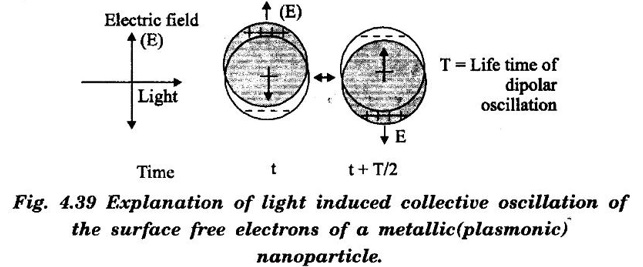
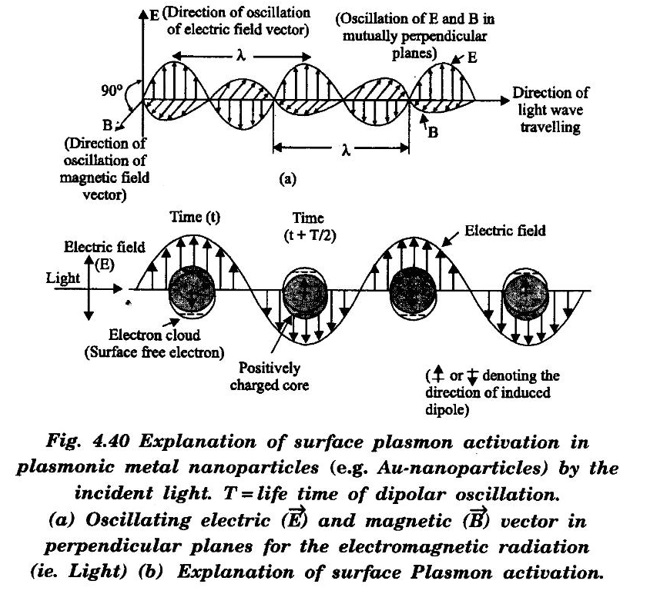
PLASMONICS • Plasmonics or nanoplasmonics refers to the generation, detection and manipulation of signals at optical frequencies frequencies along metal-dielectric interfaces in the nanometer scale. • Inspired by photonics, plasmonics follows the trend of miniaturizing optical devices and find applications in sensing, microscopy, optical communications, and bio-photonics. • Plasmon is the collective oscillation of conduction electrons in metals. The resonance energy depends on the particle size and shape, and the permittivity (dielectric constant) of the material itself and surrounding materials. Plasmonics typically utilizes so-called Surface Plasmon Polaritons (SPPs) that are coherent electron oscillations travelling together with an electromagnetic wave along the interface between a dielectric (e.g. glass, air) and a metal (e.g. silver, gold). The SPP modes are strongly confined to their supporting interface, giving rise to strong light- matter interactions. In particular, the electron gas in the metal oscillates with the electro- magnetic wave. Because the moving electrons are scattered, ohmic losses in plasmonic signals are generally large. It limits the signal transfer distances to the sub-centimeter range, unless hybrid optoplasmonic light guiding network, or Plasmon gain amplification are used. The collective oscillation of the free electrons with respect to the fixed positions of the positively charged nuclei (acting as the core) is called plasmon. In the case of a metallic nanoparticle where there is a large fraction of atoms as the surface atoms, the free surface electrons can collectively oscillate to produce the surface plasmon (SP). But due to the quantum confinement, the surface plasmon is localized and it is called the Localized Surface Plasmon (LSP). When a nanoparticle is exposed to light, its oscillating electric vector of light can induce a collective oscillation of free electrons of the metal nanoparticles. In other words, the incident light can cause a oscillating a dipole moment. Thus, this leads to charge separation generating a dipole oscillation along the direction of the electric field of the light. Thus is explained for a spherical nanoparticle in fig. 4.39. For a particular nanoparticle, the amplitude of light induced collective oscillation of free surface electrons reaches maximum at a specific frequency of the incident light. It produces the surface plasmon resonance (SPR) and the light is absorbed (called plasmon absorption). In other words, when frequency of the incident electromagnetic radiation matches the inherent frequency of surface plasmon, SPR occurs and the light absorption is observed. (Fig.4.41) • Plasmonic gold and silver nanoparticles have unique optical, electrical, and thermal properties and hence are used in applications such as antimicrobial coatings and molecular diagnostics. Color engineering. • The unique optical properties of metal nanoparticles are very useful in color engineering. • Plasmonics (or nanoplasmonics) is a young topic of research, which is part of nanophotonics and nano-optics. Plasmonics concerns to the investigation of electron oscillations in metallic nanostructures and nanoparticles.Principle
Surface Plasmon Resonance (SPR)
Uses of Plasmonics
Materials Science: Unit IV: Optical Properties of Materials : Tag: : Principle, Surface Plasmon Resonance, Uses - Plasmonics
Materials Science: Unit IV: Optical Properties of Materials
Under Subject
Materials Science
PH3251 2nd semester Mechanical Dept | 2021 Regulation | 2nd Semester Mechanical Dept 2021 Regulation
Related Subjects

Professional English II
HS3251 2nd Semester 2021 Regulation | 2nd Semester Common to all Dept 2021 Regulation
Statistics and Numerical Methods
MA3251 2nd Semester 2021 Regulation M2 Engineering Mathematics 2 | 2nd Semester Common to all Dept 2021 Regulation
Engineering Graphics
GE3251 eg 2nd semester | 2021 Regulation | 2nd Semester Common to all Dept 2021 Regulation
Physics for Electrical Engineering
PH3202 2nd Semester 2021 Regulation | 2nd Semester EEE Dept 2021 Regulation
Basic Civil and Mechanical Engineering
BE3255 2nd Semester 2021 Regulation | 2nd Semester EEE Dept 2021 Regulation
Electric Circuit Analysis
EE3251 2nd Semester 2021 Regulation | 2nd Semester EEE Dept 2021 Regulation
Physics for Electronics Engineering
PH3254 - Physics II - 2nd Semester - ECE Department - 2021 Regulation | 2nd Semester ECE Dept 2021 Regulation
Electrical and Instrumentation Engineering
BE3254 - 2nd Semester - ECE Dept - 2021 Regulation | 2nd Semester ECE Dept 2021 Regulation
Circuit Analysis
EC3251 - 2nd Semester - ECE Dept - 2021 Regulation | 2nd Semester ECE Dept 2021 Regulation
Materials Science
PH3251 2nd semester Mechanical Dept | 2021 Regulation | 2nd Semester Mechanical Dept 2021 Regulation
Basic Electrical and Electronics Engineering
BE3251 2nd semester Mechanical Dept | 2021 Regulation | 2nd Semester Mechanical Dept 2021 Regulation
Physics for Civil Engineering
PH3201 2021 Regulation | 2nd Semester Civil Dept 2021 Regulation
Basic Electrical, Electronics and Instrumentation Engineering
BE3252 2021 Regulation | 2nd Semester Civil Dept 2021 Regulation
Physics for Information Science
PH3256 2nd Semester CSE Dept | 2021 Regulation | 2nd Semester CSE Dept 2021 Regulation
Basic Electrical and Electronics Engineering
BE3251 2nd Semester CSE Dept 2021 | Regulation | 2nd Semester CSE Dept 2021 Regulation
Programming in C
CS3251 2nd Semester CSE Dept 2021 | Regulation | 2nd Semester CSE Dept 2021 Regulation