Materials Science: Unit IV: Optical Properties of Materials
Absorption and Emission of Light in Semiconductors
In semiconductors, light photons is absorbed in several ways.
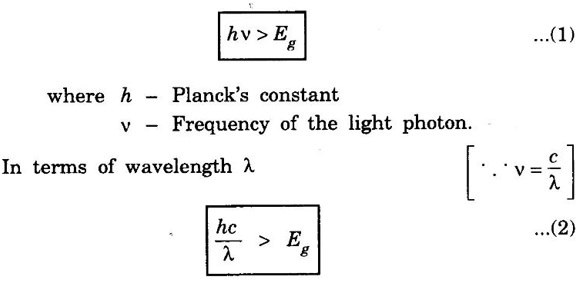
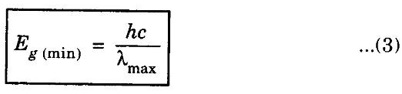
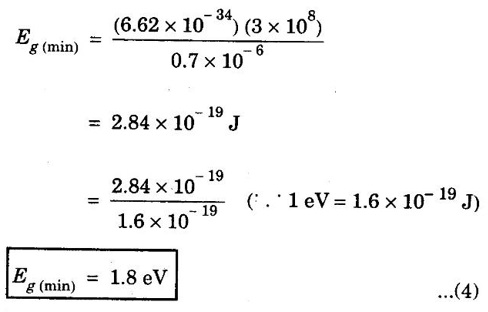
ABSORPTION AND EMISSION OF LIGHT IN SEMICONDUCTORS In semiconductors, light photons is absorbed in several ways. In intrinsic (pure) semiconductors such as Si, Ge and GaAs, light photons is absorbed to create electron-hole pairs. This absorption causes electrons to jump across the energy band gap from the valence band to the conduction band as shown in fig. 4.2(a). This transition occurs ie., the excitation of electrons due to absorption can take place if the photon energy is greater than that of the band gap Eg, that is if The maximum wavelength for visible light λmax is about 0.7 μm. Therefore, the minimum band gap energy Eg(min) for which there is absorption of visible light is given by Substituting the corresponding values, we have The result indicates that all visible light is absorbed by those semiconductors having band gap energies less than about 1.8 eV. Thus, these semiconductors are opaque. In extrinsic (impure) semiconductors, the presence of acceptor and donor impurities creates new energy levels namely acceptor level (Ea) (p-type semiconductor) and donor level (Ed) (n-type semiconductor) as shown in fig. 4.4 (b) and (c). These impurity levels lie within the band gap of the material. Light radiation of specific wavelength may be absorbed as a result of electron transitions from or to these impurity levels within the band gap.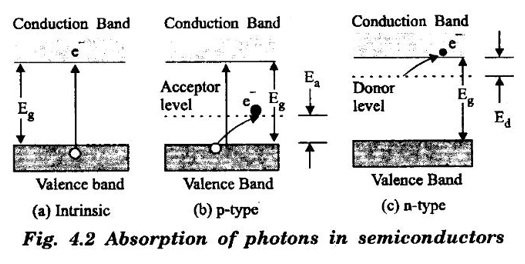
Materials Science: Unit IV: Optical Properties of Materials : Tag: : - Absorption and Emission of Light in Semiconductors
Materials Science: Unit IV: Optical Properties of Materials
Under Subject
Materials Science
PH3251 2nd semester Mechanical Dept | 2021 Regulation | 2nd Semester Mechanical Dept 2021 Regulation
Related Subjects

Professional English II
HS3251 2nd Semester 2021 Regulation | 2nd Semester Common to all Dept 2021 Regulation
Statistics and Numerical Methods
MA3251 2nd Semester 2021 Regulation M2 Engineering Mathematics 2 | 2nd Semester Common to all Dept 2021 Regulation
Engineering Graphics
GE3251 eg 2nd semester | 2021 Regulation | 2nd Semester Common to all Dept 2021 Regulation
Physics for Electrical Engineering
PH3202 2nd Semester 2021 Regulation | 2nd Semester EEE Dept 2021 Regulation
Basic Civil and Mechanical Engineering
BE3255 2nd Semester 2021 Regulation | 2nd Semester EEE Dept 2021 Regulation
Electric Circuit Analysis
EE3251 2nd Semester 2021 Regulation | 2nd Semester EEE Dept 2021 Regulation
Physics for Electronics Engineering
PH3254 - Physics II - 2nd Semester - ECE Department - 2021 Regulation | 2nd Semester ECE Dept 2021 Regulation
Electrical and Instrumentation Engineering
BE3254 - 2nd Semester - ECE Dept - 2021 Regulation | 2nd Semester ECE Dept 2021 Regulation
Circuit Analysis
EC3251 - 2nd Semester - ECE Dept - 2021 Regulation | 2nd Semester ECE Dept 2021 Regulation
Materials Science
PH3251 2nd semester Mechanical Dept | 2021 Regulation | 2nd Semester Mechanical Dept 2021 Regulation
Basic Electrical and Electronics Engineering
BE3251 2nd semester Mechanical Dept | 2021 Regulation | 2nd Semester Mechanical Dept 2021 Regulation
Physics for Civil Engineering
PH3201 2021 Regulation | 2nd Semester Civil Dept 2021 Regulation
Basic Electrical, Electronics and Instrumentation Engineering
BE3252 2021 Regulation | 2nd Semester Civil Dept 2021 Regulation
Physics for Information Science
PH3256 2nd Semester CSE Dept | 2021 Regulation | 2nd Semester CSE Dept 2021 Regulation
Basic Electrical and Electronics Engineering
BE3251 2nd Semester CSE Dept 2021 | Regulation | 2nd Semester CSE Dept 2021 Regulation
Programming in C
CS3251 2nd Semester CSE Dept 2021 | Regulation | 2nd Semester CSE Dept 2021 Regulation