Materials Science: Unit IV: Optical Properties of Materials
Organic Semiconductors: Optical Processes and Devices
In the last 1980s the interest in organic semiconductors demonstrated by the invention of electroluminescent devices and FETs made from polythiophene.
ORGANIC SEMICONDUCTORS: OPTICAL PROCESSES AND DEVICES In the last 1980s the interest in organic semiconductors demonstrated by the invention of electroluminescent devices and FETs made from polythiophene. Polymer-based devices are now used for back-lights of liquid crystal displays, displays of devices, such as cell phones or watches. It is used in that commercial technologies, such as televisions, solar cells, etc., will benefit from new advances. Polymer LEDs were first demonstrated in 1990. They are very attractive because of potential large area applications and mechanical flexibility. The organic diode is usually not fabricated by doping the polymer itself. Instead an undoped polymer film is placed between an anode (indium tin oxide) and a cathode (e.g., calcium). In organic semiconductors, the nature of atomic bonding results in very narrow range energy levels. Figure 4.26 shows a diagram of a metal-organic- semiconductor junction. When the Fermi energy of the metal is close to the HOMO level, electrons from the this level can move into the metal (a hole is injected into semiconductor. Thus in this case the metal acts as a p-type contact. When the metal work functions are close to the LUMO state, as shown in fig. 4.26 an n-type contact results. The current flow in a p - n diode using an organic semiconductor film is shown in fig.(c). Thus, the n-contact injects an electron, while diffuses into the semiconductor. Then, eventually recombining with a hole in the HOMO level. The electron finally leaves the HOMO state (i.e., a hole is injected). It is also possible to have heterojunctions between different organic semiconductors. The process of photon emission by electron-hole recombination in organic semiconductors significantly different from that of inorganic semiconductors. The difference is due to the formation of exciton state. It is a bound state of electron and hole is a e - h interacting through Coulombic interaction.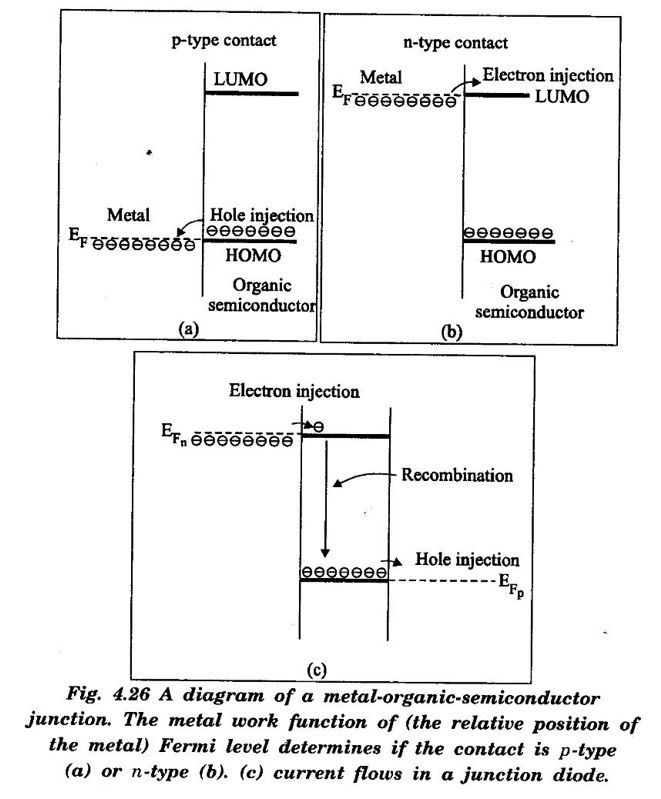
Materials Science: Unit IV: Optical Properties of Materials : Tag: : - Organic Semiconductors: Optical Processes and Devices
Materials Science: Unit IV: Optical Properties of Materials
Under Subject
Materials Science
PH3251 2nd semester Mechanical Dept | 2021 Regulation | 2nd Semester Mechanical Dept 2021 Regulation
Related Subjects
Professional English II
HS3251 2nd Semester 2021 Regulation | 2nd Semester Common to all Dept 2021 Regulation
Statistics and Numerical Methods
MA3251 2nd Semester 2021 Regulation M2 Engineering Mathematics 2 | 2nd Semester Common to all Dept 2021 Regulation
Engineering Graphics
GE3251 eg 2nd semester | 2021 Regulation | 2nd Semester Common to all Dept 2021 Regulation
Physics for Electrical Engineering
PH3202 2nd Semester 2021 Regulation | 2nd Semester EEE Dept 2021 Regulation
Basic Civil and Mechanical Engineering
BE3255 2nd Semester 2021 Regulation | 2nd Semester EEE Dept 2021 Regulation
Electric Circuit Analysis
EE3251 2nd Semester 2021 Regulation | 2nd Semester EEE Dept 2021 Regulation
Physics for Electronics Engineering
PH3254 - Physics II - 2nd Semester - ECE Department - 2021 Regulation | 2nd Semester ECE Dept 2021 Regulation
Electrical and Instrumentation Engineering
BE3254 - 2nd Semester - ECE Dept - 2021 Regulation | 2nd Semester ECE Dept 2021 Regulation
Circuit Analysis
EC3251 - 2nd Semester - ECE Dept - 2021 Regulation | 2nd Semester ECE Dept 2021 Regulation
Materials Science
PH3251 2nd semester Mechanical Dept | 2021 Regulation | 2nd Semester Mechanical Dept 2021 Regulation
Basic Electrical and Electronics Engineering
BE3251 2nd semester Mechanical Dept | 2021 Regulation | 2nd Semester Mechanical Dept 2021 Regulation
Physics for Civil Engineering
PH3201 2021 Regulation | 2nd Semester Civil Dept 2021 Regulation
Basic Electrical, Electronics and Instrumentation Engineering
BE3252 2021 Regulation | 2nd Semester Civil Dept 2021 Regulation
Physics for Information Science
PH3256 2nd Semester CSE Dept | 2021 Regulation | 2nd Semester CSE Dept 2021 Regulation
Basic Electrical and Electronics Engineering
BE3251 2nd Semester CSE Dept 2021 | Regulation | 2nd Semester CSE Dept 2021 Regulation
Programming in C
CS3251 2nd Semester CSE Dept 2021 | Regulation | 2nd Semester CSE Dept 2021 Regulation