Materials Science: Unit IV: Optical Properties of Materials
Light Emitting Diode (LED)
Construction, Working Principle, VI Characteristics, Advantages, Disadvantages, Applications, Uses
It is a p-n junction diode which emits light when it is forward biased.
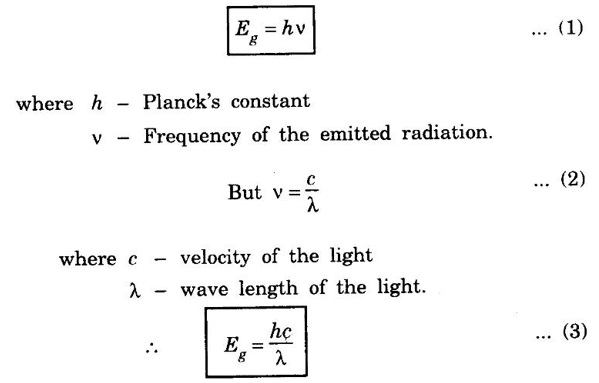
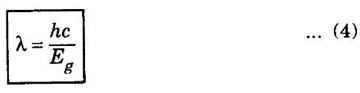
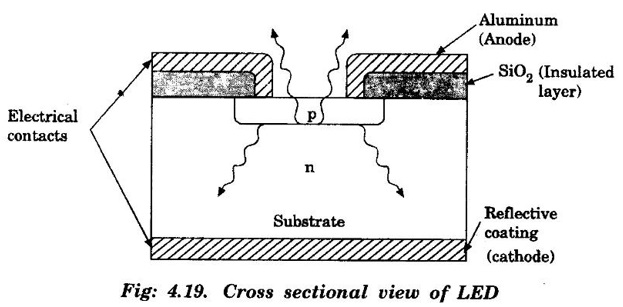
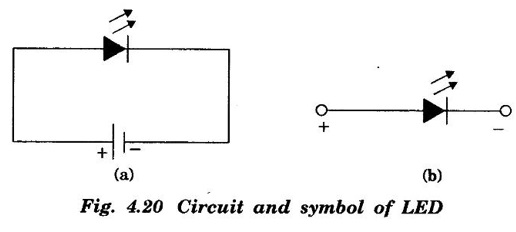
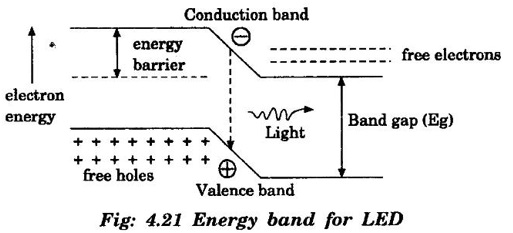
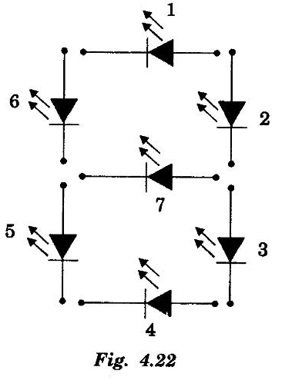
LIGHT EMITTING DIODE (LED) It is a p-n junction diode which emits light when it is forward biased. The injection of electrons into the p- region from n- region makes a direct transition from the conduction band to valence band. Then, the electrons recombine with holes and emits photons of energy Eg. The forbidden energy gap is given by Hence, the wavelength of the emitted photon is given by the relation The wave length of the light emitted purely depends on the band gap energy. Note: Bandgap energy Eg (generally in eV) should be converted into joule unit. [1 eV 1.6 × 10⁻¹⁹ J] Fig. 4.19 shows cross sectional view of a LED. A n - type layer is grown on a substrate and a p - type layer is deposited on it by diffusion. Since carrier recombination takes place in the p - player, it is deposited on the top. For maximum light emission, a metal film anode is deposited at the outer edges of the p - type layer. The bottom of the substrate is coated with a metal (gold) film. It reflects most of the light to the surface of the device and also provides cathode connection. Fig. 4.20 shows circuit and symbol of LED. When the p-n junction diode is forward biased, the barrier width is reduced, raising the potential energy on the n - side and lowering that of the p-side. The free electrons and holes have sufficient energy to move into the junction region. If a free electron meets a hole, it recombines with each other resulting in the release of a light photon. Thus, light radiation from LED is caused by the recombination of holes and electrons that are injected into the junction by a forward bias voltage. (Fig. 4.21) • LEDs are smaller in size. A number of LEDs can be stacked together in a small space to form numerical display. • LED's can be turned ON and OFF in less than 1 nano second (10-9 second). So, they are known as fast devices. • Variety of LEDs are available which emit light in different colours like red, green, yellow etc. • Light modulation can be achieved with pulse supply. • It has long life time. • It has low drive voltage and low noise. • It is easily interfaced to digital logic circuits. • It can be operated over a wide range of temperatures. • They require high power. • Their preparation cost is high when compared to LCD. • Because of their miniature size, they are widely used in numeric and alphanumeric display devices. (Fig. 4.22) • They are used as indicator lamps. • They are used as light sources in fiber-optic communication system. • Infrared LEDs are used in burglar alarms. • They are used in image sensing circuits used for picture phone. • They are used as a pilot light. • Infra red LEDs are widely used with photo diodes or photo transistors to enable short range wire-less communication.Principle
Construction:
Working
Advantages of LEDs
Disadvantages of LEDs
Applications and uses of LEDs
Materials Science: Unit IV: Optical Properties of Materials : Tag: : Construction, Working Principle, VI Characteristics, Advantages, Disadvantages, Applications, Uses - Light Emitting Diode (LED)
Materials Science: Unit IV: Optical Properties of Materials
Under Subject
Materials Science
PH3251 2nd semester Mechanical Dept | 2021 Regulation | 2nd Semester Mechanical Dept 2021 Regulation
Related Subjects

Professional English II
HS3251 2nd Semester 2021 Regulation | 2nd Semester Common to all Dept 2021 Regulation
Statistics and Numerical Methods
MA3251 2nd Semester 2021 Regulation M2 Engineering Mathematics 2 | 2nd Semester Common to all Dept 2021 Regulation

Engineering Graphics
GE3251 eg 2nd semester | 2021 Regulation | 2nd Semester Common to all Dept 2021 Regulation
Physics for Electrical Engineering
PH3202 2nd Semester 2021 Regulation | 2nd Semester EEE Dept 2021 Regulation

Basic Civil and Mechanical Engineering
BE3255 2nd Semester 2021 Regulation | 2nd Semester EEE Dept 2021 Regulation
Electric Circuit Analysis
EE3251 2nd Semester 2021 Regulation | 2nd Semester EEE Dept 2021 Regulation
Physics for Electronics Engineering
PH3254 - Physics II - 2nd Semester - ECE Department - 2021 Regulation | 2nd Semester ECE Dept 2021 Regulation

Electrical and Instrumentation Engineering
BE3254 - 2nd Semester - ECE Dept - 2021 Regulation | 2nd Semester ECE Dept 2021 Regulation
Circuit Analysis
EC3251 - 2nd Semester - ECE Dept - 2021 Regulation | 2nd Semester ECE Dept 2021 Regulation
Materials Science
PH3251 2nd semester Mechanical Dept | 2021 Regulation | 2nd Semester Mechanical Dept 2021 Regulation

Basic Electrical and Electronics Engineering
BE3251 2nd semester Mechanical Dept | 2021 Regulation | 2nd Semester Mechanical Dept 2021 Regulation

Physics for Civil Engineering
PH3201 2021 Regulation | 2nd Semester Civil Dept 2021 Regulation
Basic Electrical, Electronics and Instrumentation Engineering
BE3252 2021 Regulation | 2nd Semester Civil Dept 2021 Regulation

Physics for Information Science
PH3256 2nd Semester CSE Dept | 2021 Regulation | 2nd Semester CSE Dept 2021 Regulation

Basic Electrical and Electronics Engineering
BE3251 2nd Semester CSE Dept 2021 | Regulation | 2nd Semester CSE Dept 2021 Regulation

Programming in C
CS3251 2nd Semester CSE Dept 2021 | Regulation | 2nd Semester CSE Dept 2021 Regulation