Materials Science: Unit IV: Optical Properties of Materials
Carrier Generation and Recombination Processes
Optical Properties of Materials
The carrier generation is the process whereby electrons and holes are created. The recombination is the process whereby electrons and holes are annihilated.
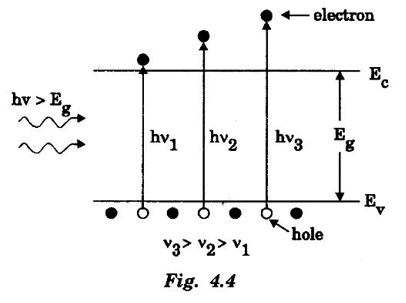
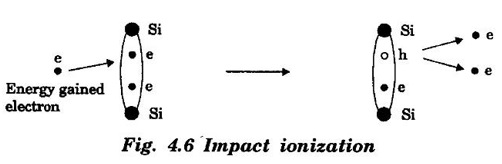
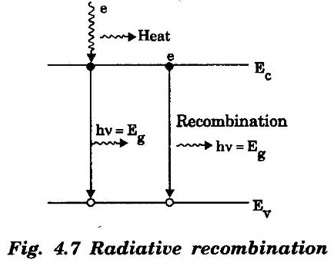
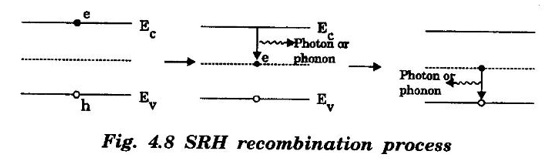
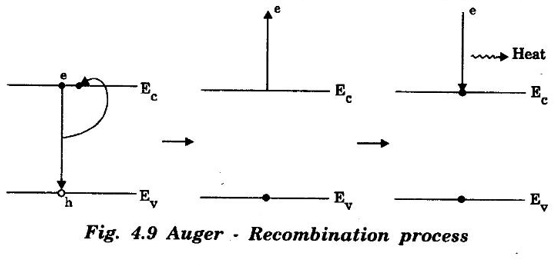
CARRIER GENERATION AND RECOMBINATION PROCESSES The carrier generation is the process whereby electrons and holes are created. The recombination is the process whereby electrons and holes are annihilated. Basically, there are three types of carrier generations. They are (i) Photogeneration (ii) Phonon generation (iii) Impact ionization In photogeneration, light of frequency v falls on a semiconductor. Let hv be the energy of light photon greater than the bandgap of the semiconductor. Figure 4.4 shows the absorption of light energy hv (> Eg). By absorption of light photon, one electron jumps from valence band to conduction band generating an electron-hole pair. For different wavelengths of light with different energies (hv2, hv3) it can take an electron in higher conduction band states. Phonon generation occurs when a semiconductor is under thermal excitation. With increase in temperature of the semiconductor, lattice vibrations increase which give rise to more phonons. Due to more lattice vibrations, covalent bonds in the semiconductor break down and electron-hole pairs are generated. (Fig. 4.5) In this process, one energetic charge carrier will create another charge carrier. When a semiconductor is under an electric field, electrons gain energy from the applied electric field and hit other Si-atoms. In this process, a bond breaks out generating more carriers. For a very high electric field, it results in a avalanche breakdown. (Fig. 4.6) In recombination, a pair of electron and hole gets recombined. When a free electron in the conduction band falls to valence band and recombines with a hole, it becomes a bound electron in valence band. (a) Radiative Recombination (b) Shockley-Read-Hall Recombination (c) Auger Recombination It occurs for direct band semiconductors (like GaAs). In this process, electrons from conduction band minimum falls to valence band maximum without changing the momentum. In this process, one photon of energy hv (= Eg) is emitted. Electrons which are excited to higher energy states in conduction band will come to the conduction band minimum by releasing energy as heat. Then, from conduction band minimum it falls to valence band maximum emitting light of energy hv = Eg. It is also called direct recombination. (Fig. 4.8) In this recombination process, electrons from conduction band minimum come to a defect level intermediate between Ec and Ev by radiating energy as photons or phonons. Then, electron turns from that intermediate level to the valence band. This type of recombination is basically seen in impure semiconductor which has defect levels. Generally, the defect level lies in the middle of the forbidden gap. (Fig. 4.8) In Auger recombination, three carriers are involved. In this process, an electron and a hole recombine and the energy is given to the third free electron in the conduction band. Then, the third excited electron comes back to the conduction band edge by emitting energy as heat. Generally, an Auger recombination occurs for heavily doped material. (Fig. 4.9)Carrier Generation
(i) Photogeneration
(ii) Phonon Generation

(iii) Impact Ionization
Recombination

Recombination occurs in three ways:
(a) Radiative Recombination
Shockley-Read-Hall Recombination
Auger Recombination
Materials Science: Unit IV: Optical Properties of Materials : Tag: : Optical Properties of Materials - Carrier Generation and Recombination Processes
Materials Science: Unit IV: Optical Properties of Materials
Under Subject
Materials Science
PH3251 2nd semester Mechanical Dept | 2021 Regulation | 2nd Semester Mechanical Dept 2021 Regulation
Related Subjects
Professional English II
HS3251 2nd Semester 2021 Regulation | 2nd Semester Common to all Dept 2021 Regulation
Statistics and Numerical Methods
MA3251 2nd Semester 2021 Regulation M2 Engineering Mathematics 2 | 2nd Semester Common to all Dept 2021 Regulation
Engineering Graphics
GE3251 eg 2nd semester | 2021 Regulation | 2nd Semester Common to all Dept 2021 Regulation
Physics for Electrical Engineering
PH3202 2nd Semester 2021 Regulation | 2nd Semester EEE Dept 2021 Regulation
Basic Civil and Mechanical Engineering
BE3255 2nd Semester 2021 Regulation | 2nd Semester EEE Dept 2021 Regulation
Electric Circuit Analysis
EE3251 2nd Semester 2021 Regulation | 2nd Semester EEE Dept 2021 Regulation
Physics for Electronics Engineering
PH3254 - Physics II - 2nd Semester - ECE Department - 2021 Regulation | 2nd Semester ECE Dept 2021 Regulation
Electrical and Instrumentation Engineering
BE3254 - 2nd Semester - ECE Dept - 2021 Regulation | 2nd Semester ECE Dept 2021 Regulation
Circuit Analysis
EC3251 - 2nd Semester - ECE Dept - 2021 Regulation | 2nd Semester ECE Dept 2021 Regulation
Materials Science
PH3251 2nd semester Mechanical Dept | 2021 Regulation | 2nd Semester Mechanical Dept 2021 Regulation
Basic Electrical and Electronics Engineering
BE3251 2nd semester Mechanical Dept | 2021 Regulation | 2nd Semester Mechanical Dept 2021 Regulation
Physics for Civil Engineering
PH3201 2021 Regulation | 2nd Semester Civil Dept 2021 Regulation
Basic Electrical, Electronics and Instrumentation Engineering
BE3252 2021 Regulation | 2nd Semester Civil Dept 2021 Regulation
Physics for Information Science
PH3256 2nd Semester CSE Dept | 2021 Regulation | 2nd Semester CSE Dept 2021 Regulation
Basic Electrical and Electronics Engineering
BE3251 2nd Semester CSE Dept 2021 | Regulation | 2nd Semester CSE Dept 2021 Regulation
Programming in C
CS3251 2nd Semester CSE Dept 2021 | Regulation | 2nd Semester CSE Dept 2021 Regulation