Materials Science: Unit V: Nanoelectronic Devices
Single Electron Phenomena
Definition, Formula, Tunneling, Condition
In electronics, transistor is the most important device. Transistors are what computers use to compute-tiny switches turning ON and OFF making logic decisions.
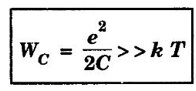
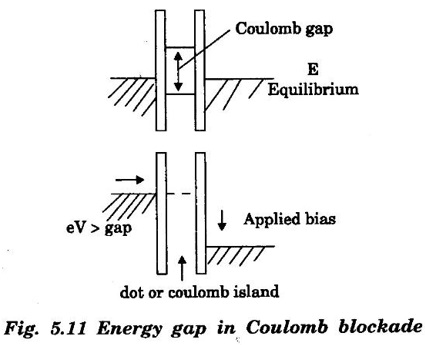
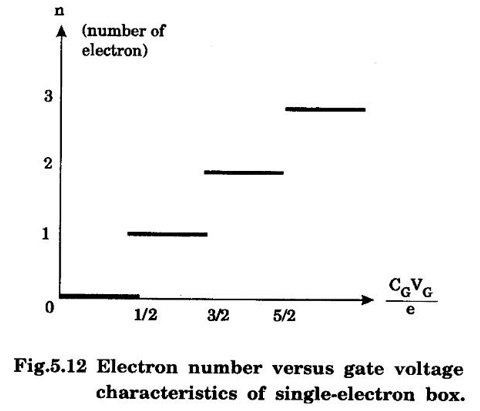
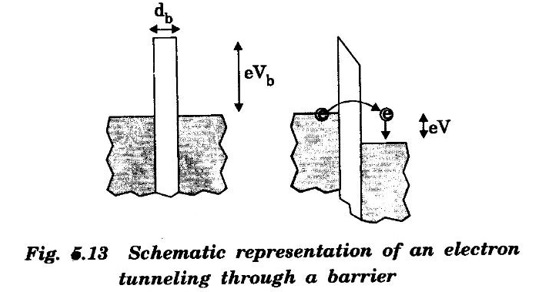
SINGLE ELECTRON PHENOMENA In electronics, transistor is the most important device. Transistors are what computers use to compute-tiny switches turning ON and OFF making logic decisions. Today, microchips have over a billion transistors, each one turning ON and OFF a billion times every second. These chips require manufacturing processes with roughly sub 100-nanometre resolution. Every year, this technology resolution drops enabling even smaller transistors. Thus, more transistors are squeezed into the same amount of semiconductor space. Interestingly, when each transistor is reducing to a few atoms, or a single molecule, quantum effects will play a significant role. In 1970, to switch ON a silicon transistor, it required about 10 million electrons. Present day, transistors require closer to 10,000 electrons. Rather than moving many electrons through transistors, it may very well be practical and necessary to move electrons one at a time. The single electron devices are sensitive to the transfer of even single electron charge. Single electron devices provide a potential application of ultra large scale integrated circuits with. device size in the order of nanometres. They exhibit high speed operation with low power dissipation. As the size of the quantum dot decreases, the charging energy Wc of a single excess charge on the dot increases. If the quantum-dot size is sufficiently small and the charging energy Wc is much greater than thermal energy k T, no electron tunnels to and from the quantum dot. Thus, the electron number in the dot takes a fixed value, say zero, when both the electrodes are grounded. The charging effect which blocks the injection or rejection of a single charge into or from a quantum dot is called Coulomb blockade effect. If two or more charges near one another, they exert coulomb forces upon each other. If two charges are the same kind, the force is repulsive. Therefore, the condition for observing coulomb blockade effects is expressed as where C - capacitance of the quantum dot T - temperature of the system. Wc - charging energy and this is the energy needed to add one negatively charged electron to the dot. From the above equation (1), we can notice that WC is inversely proportional to the quantum dot's capacitance. Thus, a larger capacitor can quite accommodate another electron without too much energy required. In the contrary, with extremely small capacitors, (C = 10-19 F) like quantum dots, the charging energy is substantial and it can be large enough to "block" tunneling electrons as shown in fig. 5.11. By refering fig. 5.12, it should be noted that by applying a positive bias to the gate electrode, an electron can be attracted to the quantum dot. The increase of the gate voltage attracts an electron more strongly to the quantum dot. When the gate bias exceeds a certain value an electron enters quantum dot and the number of electron in the dot becomes one. Further, increase of the gate voltage makes it possible to make the electron number two and so on as in fig. 5.6. Thus, in the single-electron box, the electron number of the quantum dot is controlled, one by one, by utilizing the gate electrode. Tunneling is the way the electrons cross both the physical barriers and the energy barriers separating a quantum dot from the bulk material that surrounds it. If any number of electrons on one side of the barrier could just tunnel across it, there would not be any isolation. So it is necessary to control the addition and removal of electrons in a quantum dot. When the size gets reduced, the capacitance also reduces to a small value. (Fig. 5.13) At small sizes, the energy required to store an additional electron on it, W = Q2 / 2C, may become larger than the thermal energy k T. As a consequence, the quantization of charge can dominate and tunneling of single electrons across leaky capacitors carries the current. This is called single electron tunneling. It is used to design new types of devices, for example single-electron transistor using quantum dots. So single-electron device are devices that can control the motion of even a single electron and consist of quantum dots which have tunnel junctions.Coulomb - Blockade Effects
Definition
Condition for coulomb blockade
Single Electron Tunneling
Materials Science: Unit V: Nanoelectronic Devices : Tag: : Definition, Formula, Tunneling, Condition - Single Electron Phenomena
Materials Science: Unit V: Nanoelectronic Devices
Under Subject

Materials Science
PH3251 2nd semester Mechanical Dept | 2021 Regulation | 2nd Semester Mechanical Dept 2021 Regulation
Related Subjects

Professional English II
HS3251 2nd Semester 2021 Regulation | 2nd Semester Common to all Dept 2021 Regulation
Statistics and Numerical Methods
MA3251 2nd Semester 2021 Regulation M2 Engineering Mathematics 2 | 2nd Semester Common to all Dept 2021 Regulation

Engineering Graphics
GE3251 eg 2nd semester | 2021 Regulation | 2nd Semester Common to all Dept 2021 Regulation

Physics for Electrical Engineering
PH3202 2nd Semester 2021 Regulation | 2nd Semester EEE Dept 2021 Regulation

Basic Civil and Mechanical Engineering
BE3255 2nd Semester 2021 Regulation | 2nd Semester EEE Dept 2021 Regulation
Electric Circuit Analysis
EE3251 2nd Semester 2021 Regulation | 2nd Semester EEE Dept 2021 Regulation
Physics for Electronics Engineering
PH3254 - Physics II - 2nd Semester - ECE Department - 2021 Regulation | 2nd Semester ECE Dept 2021 Regulation

Electrical and Instrumentation Engineering
BE3254 - 2nd Semester - ECE Dept - 2021 Regulation | 2nd Semester ECE Dept 2021 Regulation
Circuit Analysis
EC3251 - 2nd Semester - ECE Dept - 2021 Regulation | 2nd Semester ECE Dept 2021 Regulation
Materials Science
PH3251 2nd semester Mechanical Dept | 2021 Regulation | 2nd Semester Mechanical Dept 2021 Regulation

Basic Electrical and Electronics Engineering
BE3251 2nd semester Mechanical Dept | 2021 Regulation | 2nd Semester Mechanical Dept 2021 Regulation

Physics for Civil Engineering
PH3201 2021 Regulation | 2nd Semester Civil Dept 2021 Regulation

Basic Electrical, Electronics and Instrumentation Engineering
BE3252 2021 Regulation | 2nd Semester Civil Dept 2021 Regulation
Physics for Information Science
PH3256 2nd Semester CSE Dept | 2021 Regulation | 2nd Semester CSE Dept 2021 Regulation

Basic Electrical and Electronics Engineering
BE3251 2nd Semester CSE Dept 2021 | Regulation | 2nd Semester CSE Dept 2021 Regulation
Programming in C
CS3251 2nd Semester CSE Dept 2021 | Regulation | 2nd Semester CSE Dept 2021 Regulation