Materials Science: Unit V: Nanoelectronic Devices
Quantum Interference Effect
Superposition, Applications, QUIT
It is a fundamental principle of quantum mechanics.
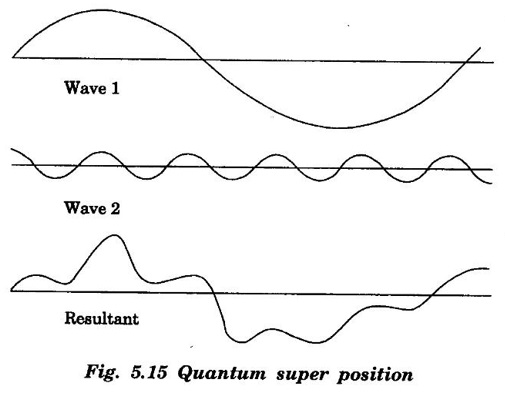
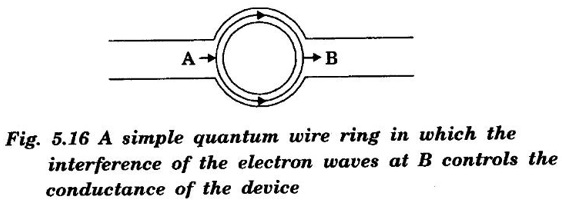
QUANTUM INTERFERENCE EFFECT It is a fundamental principle of quantum mechanics. It states that much like waves in classical physics, any two (or more) quantum states can be added together ("superposed") and the result will be another valid quantum state. (Fig. 5.15) Magnetic fields can produce and control interference effects between the electrons in solids. In order to observe interference effects between different electron waves, their phase has to be maintained. The phase coherence length Lϕ is the distance travelled by an electron without changing its phase. The phase of an electron wave is generally destroyed when electrons interact inelastically with defects in the lattice. In general, ballistic electrons with a mean free path le much larger than sample dimensions L, (i.e. le >> L,) travel through the lattice without scattering. Therefore they show interference effects. Quantum interference effect is being applied in a growing number of applications, such as the • Superconducting Quantum Interference Device (SQUID). • quantum cryptography • quantum computing and quantum interference transistor. Electrons are made to propagate through two arms of the quantum wire ring as shown in the fig. 5.16. Suppose an electron wave enters the ring from left to right. The wave entering through "A" gets split up into two partial waves. A constructive interference can be expected to occur at “B” similar to the optical anlogue as they travel through the same distance. The constructive interference at the output of the device reduces the resistance of the ring. Various methods of introducing a phase difference of л between the two waves have been suggested. This leads to destructive interference which in turn will increase the resistance by reducing the current. An external voltage can control the nature of interference and the current. This device is expected to act as a high-speed transistor.Quantum superposition
Applications of Quantum Interference Effect
Quantum, Interference Transistor (QUIT):
Materials Science: Unit V: Nanoelectronic Devices : Tag: : Superposition, Applications, QUIT - Quantum Interference Effect
Materials Science: Unit V: Nanoelectronic Devices
Under Subject
Materials Science
PH3251 2nd semester Mechanical Dept | 2021 Regulation | 2nd Semester Mechanical Dept 2021 Regulation
Related Subjects
Professional English II
HS3251 2nd Semester 2021 Regulation | 2nd Semester Common to all Dept 2021 Regulation
Statistics and Numerical Methods
MA3251 2nd Semester 2021 Regulation M2 Engineering Mathematics 2 | 2nd Semester Common to all Dept 2021 Regulation
Engineering Graphics
GE3251 eg 2nd semester | 2021 Regulation | 2nd Semester Common to all Dept 2021 Regulation
Physics for Electrical Engineering
PH3202 2nd Semester 2021 Regulation | 2nd Semester EEE Dept 2021 Regulation

Basic Civil and Mechanical Engineering
BE3255 2nd Semester 2021 Regulation | 2nd Semester EEE Dept 2021 Regulation
Electric Circuit Analysis
EE3251 2nd Semester 2021 Regulation | 2nd Semester EEE Dept 2021 Regulation
Physics for Electronics Engineering
PH3254 - Physics II - 2nd Semester - ECE Department - 2021 Regulation | 2nd Semester ECE Dept 2021 Regulation

Electrical and Instrumentation Engineering
BE3254 - 2nd Semester - ECE Dept - 2021 Regulation | 2nd Semester ECE Dept 2021 Regulation
Circuit Analysis
EC3251 - 2nd Semester - ECE Dept - 2021 Regulation | 2nd Semester ECE Dept 2021 Regulation
Materials Science
PH3251 2nd semester Mechanical Dept | 2021 Regulation | 2nd Semester Mechanical Dept 2021 Regulation
Basic Electrical and Electronics Engineering
BE3251 2nd semester Mechanical Dept | 2021 Regulation | 2nd Semester Mechanical Dept 2021 Regulation
Physics for Civil Engineering
PH3201 2021 Regulation | 2nd Semester Civil Dept 2021 Regulation

Basic Electrical, Electronics and Instrumentation Engineering
BE3252 2021 Regulation | 2nd Semester Civil Dept 2021 Regulation
Physics for Information Science
PH3256 2nd Semester CSE Dept | 2021 Regulation | 2nd Semester CSE Dept 2021 Regulation
Basic Electrical and Electronics Engineering
BE3251 2nd Semester CSE Dept 2021 | Regulation | 2nd Semester CSE Dept 2021 Regulation
Programming in C
CS3251 2nd Semester CSE Dept 2021 | Regulation | 2nd Semester CSE Dept 2021 Regulation