Materials Science: Unit V: Nanoelectronic Devices
Applications of Carbon Nanotubes (CNTs)
The unusual properties of carbon nano tubes have many applications such as battery electrodes, electronic devices and reinforcing fibers for stronger composites etc.,
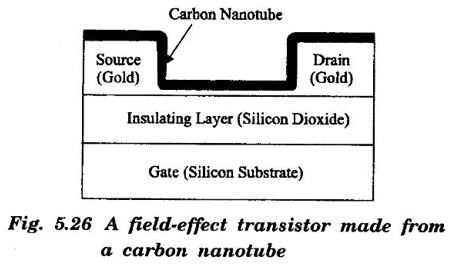
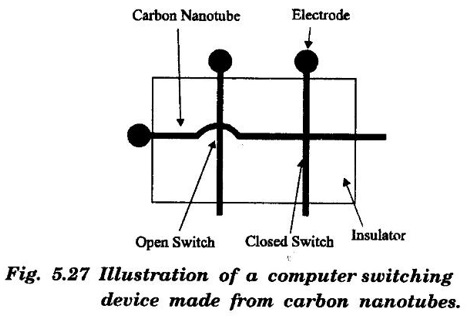
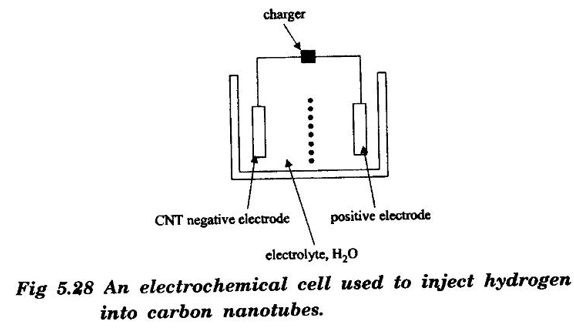
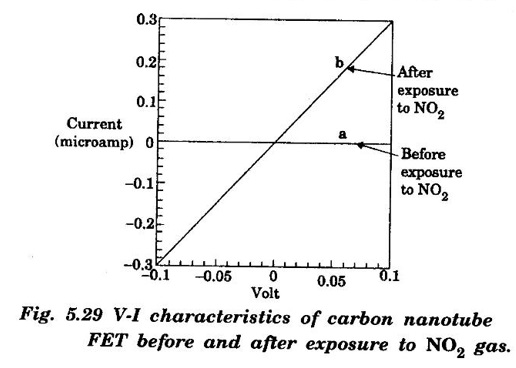
APPLICATIONS OF CARBON NANOTUBES The unusual properties of carbon nano tubes have many applications such as battery electrodes, electronic devices and reinforcing fibers for stronger composites etc., (i) When a small electrical field is applied parallel to the axis of a nanotube, the electrons are emitted at a very high rate from the ends of the tube. This is called field emission and it is used in development of flat panel displays. (ii) Vacuum tube lamps that are as bright as conventional light bulbs with long life time and more efficient can be produced using CNT. (iii) Semiconducting carbon nanotubes connecting two gold electrodes form field effect transistors (FET) device as shown in fig. 5.26. The switching time of these devices is very fast. They exhibit clock speeds of a terahertz which is 104 times faster than present processors. Further, small size allows a large number of component in a chip. (iv) Carbon nanotubes with diameters of 2 nm have extremely low resistance and thus they can carry large currents without getting heated. So, they can be used as interconnects in chip. Carbon nanotubes can be used to make a computer switching device as shown in fig. 5.27. (i) Carbon nanotubes have many applications in battery technology. Lithium which is a charge carrier in some batteries, can be stored inside nanotube. (ii) Carbon nano tube can be used for storing the hydrogen which is used in the development of fuel cells (Fig. 5.28). The cell consists of an electrolytic solution of KOH with a negative electrode consisting of carbon nanotube (CNT) paper (i) Nanotubes can be used to increase the tensile strength of steel. (ii) A plastic composite of carbon nanotubes provides light weight shielding material for electromagnetic radiation. (i) A field-effect transistor made of chiral semiconducting carbon nanotubes is used as sensitive detector of various gases (gas sensors). Fig. 5.29 shows the voltage-current characteristics before and after exposure to NO2. (ii) Nanotubes act as catalysts for some chemical reactions.Electrical and Electronics applications
Computer applications
Battery technology
Mechanical Applications
Chemical applications
Materials Science: Unit V: Nanoelectronic Devices : Tag: : - Applications of Carbon Nanotubes (CNTs)
Materials Science: Unit V: Nanoelectronic Devices
Under Subject
Materials Science
PH3251 2nd semester Mechanical Dept | 2021 Regulation | 2nd Semester Mechanical Dept 2021 Regulation
Related Subjects

Professional English II
HS3251 2nd Semester 2021 Regulation | 2nd Semester Common to all Dept 2021 Regulation
Statistics and Numerical Methods
MA3251 2nd Semester 2021 Regulation M2 Engineering Mathematics 2 | 2nd Semester Common to all Dept 2021 Regulation
Engineering Graphics
GE3251 eg 2nd semester | 2021 Regulation | 2nd Semester Common to all Dept 2021 Regulation
Physics for Electrical Engineering
PH3202 2nd Semester 2021 Regulation | 2nd Semester EEE Dept 2021 Regulation
Basic Civil and Mechanical Engineering
BE3255 2nd Semester 2021 Regulation | 2nd Semester EEE Dept 2021 Regulation
Electric Circuit Analysis
EE3251 2nd Semester 2021 Regulation | 2nd Semester EEE Dept 2021 Regulation
Physics for Electronics Engineering
PH3254 - Physics II - 2nd Semester - ECE Department - 2021 Regulation | 2nd Semester ECE Dept 2021 Regulation
Electrical and Instrumentation Engineering
BE3254 - 2nd Semester - ECE Dept - 2021 Regulation | 2nd Semester ECE Dept 2021 Regulation
Circuit Analysis
EC3251 - 2nd Semester - ECE Dept - 2021 Regulation | 2nd Semester ECE Dept 2021 Regulation
Materials Science
PH3251 2nd semester Mechanical Dept | 2021 Regulation | 2nd Semester Mechanical Dept 2021 Regulation
Basic Electrical and Electronics Engineering
BE3251 2nd semester Mechanical Dept | 2021 Regulation | 2nd Semester Mechanical Dept 2021 Regulation
Physics for Civil Engineering
PH3201 2021 Regulation | 2nd Semester Civil Dept 2021 Regulation
Basic Electrical, Electronics and Instrumentation Engineering
BE3252 2021 Regulation | 2nd Semester Civil Dept 2021 Regulation
Physics for Information Science
PH3256 2nd Semester CSE Dept | 2021 Regulation | 2nd Semester CSE Dept 2021 Regulation
Basic Electrical and Electronics Engineering
BE3251 2nd Semester CSE Dept 2021 | Regulation | 2nd Semester CSE Dept 2021 Regulation
Programming in C
CS3251 2nd Semester CSE Dept 2021 | Regulation | 2nd Semester CSE Dept 2021 Regulation