Basic Electrical and Electronics Engineering: Unit III: Analog Electronics
Resistors, Inductors and Capacitors in Electronic Circuits
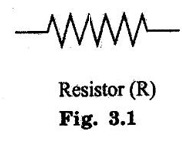
A resistor is an electrical component, which has been manufactured with a specified amount of resistance.
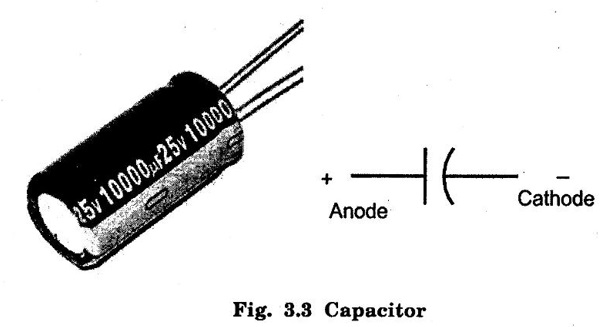
CHAPTER -3 ANALOG ELECTRONICS 1. Resistors A resistor is an electrical component, which has been manufactured with a specified amount of resistance. The resistors can conduct current in both the directions. Thus the resistors are used mainly for two purposes, namely controlling the flow of electric current and providing desired amount of voltage in an electronic circuit. 2. Inductance It is the property of a coil, which opposes changes in current by means of energy through storage in the form of magnetic field. It has been observed that a current carrying conductor or a coil has a magnetic field (or flux) associated with it. The strength of this magnetic field is directly proportional to the amount of current in the coil. As long as the current in the coil is constant, the flux is also constant. Now, if the current through the coil changes (i.e., increases or decreases), the flux linked with the coil also changes. This change in flux induces a voltage or emf in the coil. The polarity of induced voltage is such that it opposes the change in current through the coil. The magnitude of this voltage is directly proportional to the rate of change of current i.e., Where V = Magnitude of the induced voltage, dV/dt = Rate of change of current, and L = Constant of proportionality known as inductance of the coil. The inductance is a measure of the energy stored in the coil in the form of magnetic field. The unit of inductance is henry (H). In actual practice, 'henry' is an extremely large unit. Therefore we use much smaller, units like millihenry (mH) or microhenry (μH), Such that 1 mH = 10-3 H and 1μH = 10-6 H Sometimes, the inductance of a coil is also referred to as a self-inductance, in order to distinguish it from mutual inductance. It is important when we have a number of coils in a circuit and we have a self-inductance as well as the mutual inductance in the circuit. 3. Inductors (or Coils) An inductor (or a coil) is an electrical component, which is manufactured with a specified amount of inductance. The inductors are used in tuning and filter circuits. They are used in radio receivers as a built-in antenna coil to pick up radio signals. They are also used in transformers and coupled circuits to transfer (or couple) energy from one circuit to another. In many applications, the inductors are used to minimize alternating currents, while permitting flow of direct current. In such applications, the inductor is called a choke. Thus we have chokes for audio-frequency range and radio-frequency range. These chokes are called audio-frequency chokes (AFC) and radio-frequency chokes (RFC). The inductors are generally specified with inductance value and current capacity. 4. Capacitors A capacitor is an electronic component manufactured with a specified amount of capacitance. This component has an ability to charge or store energy, which neither a resistance nor an inductor can do. It opposes any change of voltage in the circuit in which it is connected. A capacitor is used in a number of applications, which are highly specialized. Some of the important applications of a capacitor are in starting motors, blocking d.c. current, passing a.c. current, filtering unwanted signals, tuning circuit to a specific frequency, coupling the electronic circuits, bypassing signals etc. A capacitor consists of two conducting plates separated by a dielectric. The dielectric is an insulating material in which an electric field can be established with little or no leakage current. The dielectrics commonly used in actual practice are air, mica, ceramic, paper, plastic, aluminum, tantalum, etc. 5. Capacitor Specifications The capacitors are specified with the type of a dielectric, capacitance value, working voltage, capacitance tolerance and its physical size. Depending upon the type of dielectric used, the capacitors are speficied as ceramic capacitors, tantalum capacitor etc. The capacitance of a capacitor is specified in either microfarads (μF) or picofarads (pF). The capacitors are manufactured with capacitance values that range from few picofarads to several thousands and microfarads. The working voltage (also called voltage rating) of a capacitor is the maximum voltage at which the capacitor may be operated continuously at a specified temperature.1. RESISTORS, INDUCTORS AND CAPACITORS IN ELECTRONIC CIRCUITS


Basic Electrical and Electronics Engineering: Unit III: Analog Electronics : Tag: : - Resistors, Inductors and Capacitors in Electronic Circuits
Basic Electrical and Electronics Engineering: Unit III: Analog Electronics
Under Subject
Basic Electrical and Electronics Engineering
BE3251 2nd semester Mechanical Dept | 2021 Regulation | 2nd Semester Mechanical Dept 2021 Regulation
Basic Electrical and Electronics Engineering
BE3251 2nd Semester CSE Dept 2021 | Regulation | 2nd Semester CSE Dept 2021 Regulation
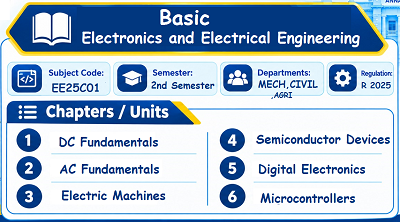
Basic Electrical and Electronics Engineering
EE25C01 2nd Semester | 2025 Regulation | 2nd Semester 2025 Regulation
Related Subjects
Professional English II
HS3251 2nd Semester 2021 Regulation | 2nd Semester Common to all Dept 2021 Regulation
Statistics and Numerical Methods
MA3251 2nd Semester 2021 Regulation M2 Engineering Mathematics 2 | 2nd Semester Common to all Dept 2021 Regulation
Engineering Graphics
GE3251 eg 2nd semester | 2021 Regulation | 2nd Semester Common to all Dept 2021 Regulation
Physics for Electrical Engineering
PH3202 2nd Semester 2021 Regulation | 2nd Semester EEE Dept 2021 Regulation
Basic Civil and Mechanical Engineering
BE3255 2nd Semester 2021 Regulation | 2nd Semester EEE Dept 2021 Regulation
Electric Circuit Analysis
EE3251 2nd Semester 2021 Regulation | 2nd Semester EEE Dept 2021 Regulation
Physics for Electronics Engineering
PH3254 - Physics II - 2nd Semester - ECE Department - 2021 Regulation | 2nd Semester ECE Dept 2021 Regulation
Electrical and Instrumentation Engineering
BE3254 - 2nd Semester - ECE Dept - 2021 Regulation | 2nd Semester ECE Dept 2021 Regulation
Circuit Analysis
EC3251 - 2nd Semester - ECE Dept - 2021 Regulation | 2nd Semester ECE Dept 2021 Regulation
Materials Science
PH3251 2nd semester Mechanical Dept | 2021 Regulation | 2nd Semester Mechanical Dept 2021 Regulation
Basic Electrical and Electronics Engineering
BE3251 2nd semester Mechanical Dept | 2021 Regulation | 2nd Semester Mechanical Dept 2021 Regulation
Physics for Civil Engineering
PH3201 2021 Regulation | 2nd Semester Civil Dept 2021 Regulation
Basic Electrical, Electronics and Instrumentation Engineering
BE3252 2021 Regulation | 2nd Semester Civil Dept 2021 Regulation
Physics for Information Science
PH3256 2nd Semester CSE Dept | 2021 Regulation | 2nd Semester CSE Dept 2021 Regulation
Basic Electrical and Electronics Engineering
BE3251 2nd Semester CSE Dept 2021 | Regulation | 2nd Semester CSE Dept 2021 Regulation
Programming in C
CS3251 2nd Semester CSE Dept 2021 | Regulation | 2nd Semester CSE Dept 2021 Regulation