Basic Electrical and Electronics Engineering: Unit III: Analog Electronics
BJT Transistor Biasing
Bipolar Junction Transistors
The main function of transistor is to do amplification. The weak signal is applied to the base of the transistor and amplified output is obtained from the collector circuit.
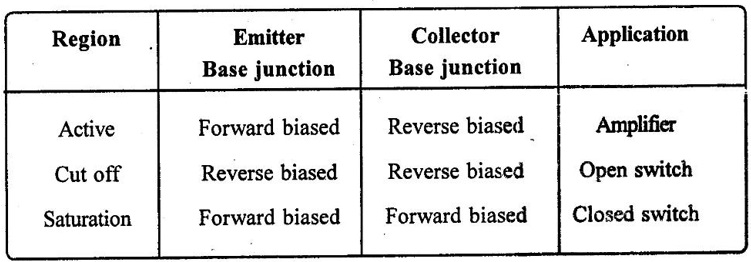
TRANSISTOR BIASING The main function of transistor is to do amplification. The weak signal is applied to the base of the transistor and amplified output is obtained from the collector circuit. The main requirement during amplification process is that only the magnitude of the signal should increase and signal shape should not get change. This increase in magnitude of the signal without any change in original signal shape is called as faithful amplification. To achieve this, input circuit (i.e. base-emitter junction) of the transistor remains forward biased and output circuit (i.e. collector base junction) always remains reverse biased during all parts of the signal. It is called as transistor biasing. The primary purpose of transistor biasing is to keep the base-emitter junction properly forward biased and collector-base junction properly reverse biased during the application of signal. It can be achieved with a bias battery or associating a circuit with a transistor. The circuit which provides transistor biasing is known as biasing circuit. The transistor biasing is very essential for the proper operation of transistor in linear region or active region. Applying external voltage of correct polarity and magnitude to the two junction. of the transistor is called Biasing Based on the external voltage polarity, the transistor will be operated in three different regions. That is (i) Active region (ii) Cutoff region and (iii) Saturation regionNeed for biasing:
1. Transistor Biasing - Operating region
Basic Electrical and Electronics Engineering: Unit III: Analog Electronics : Tag: : Bipolar Junction Transistors - BJT Transistor Biasing
Basic Electrical and Electronics Engineering: Unit III: Analog Electronics
Under Subject
Basic Electrical and Electronics Engineering
BE3251 2nd semester Mechanical Dept | 2021 Regulation | 2nd Semester Mechanical Dept 2021 Regulation
Basic Electrical and Electronics Engineering
BE3251 2nd Semester CSE Dept 2021 | Regulation | 2nd Semester CSE Dept 2021 Regulation
Basic Electrical and Electronics Engineering
EE25C01 2nd Semester | 2025 Regulation | 2nd Semester 2025 Regulation
Related Subjects
Professional English II
HS3251 2nd Semester 2021 Regulation | 2nd Semester Common to all Dept 2021 Regulation
Statistics and Numerical Methods
MA3251 2nd Semester 2021 Regulation M2 Engineering Mathematics 2 | 2nd Semester Common to all Dept 2021 Regulation
Engineering Graphics
GE3251 eg 2nd semester | 2021 Regulation | 2nd Semester Common to all Dept 2021 Regulation
Physics for Electrical Engineering
PH3202 2nd Semester 2021 Regulation | 2nd Semester EEE Dept 2021 Regulation
Basic Civil and Mechanical Engineering
BE3255 2nd Semester 2021 Regulation | 2nd Semester EEE Dept 2021 Regulation
Electric Circuit Analysis
EE3251 2nd Semester 2021 Regulation | 2nd Semester EEE Dept 2021 Regulation
Physics for Electronics Engineering
PH3254 - Physics II - 2nd Semester - ECE Department - 2021 Regulation | 2nd Semester ECE Dept 2021 Regulation
Electrical and Instrumentation Engineering
BE3254 - 2nd Semester - ECE Dept - 2021 Regulation | 2nd Semester ECE Dept 2021 Regulation
Circuit Analysis
EC3251 - 2nd Semester - ECE Dept - 2021 Regulation | 2nd Semester ECE Dept 2021 Regulation
Materials Science
PH3251 2nd semester Mechanical Dept | 2021 Regulation | 2nd Semester Mechanical Dept 2021 Regulation
Basic Electrical and Electronics Engineering
BE3251 2nd semester Mechanical Dept | 2021 Regulation | 2nd Semester Mechanical Dept 2021 Regulation
Physics for Civil Engineering
PH3201 2021 Regulation | 2nd Semester Civil Dept 2021 Regulation
Basic Electrical, Electronics and Instrumentation Engineering
BE3252 2021 Regulation | 2nd Semester Civil Dept 2021 Regulation
Physics for Information Science
PH3256 2nd Semester CSE Dept | 2021 Regulation | 2nd Semester CSE Dept 2021 Regulation
Basic Electrical and Electronics Engineering
BE3251 2nd Semester CSE Dept 2021 | Regulation | 2nd Semester CSE Dept 2021 Regulation
Programming in C
CS3251 2nd Semester CSE Dept 2021 | Regulation | 2nd Semester CSE Dept 2021 Regulation