Materials Science: Unit I: Crystallography
Plastic Deformation Mechanisms
Types: Slip, Twinning
Plastic deformation of a single crystal occurs in two ways. They are (a) Slip (b) Twinning
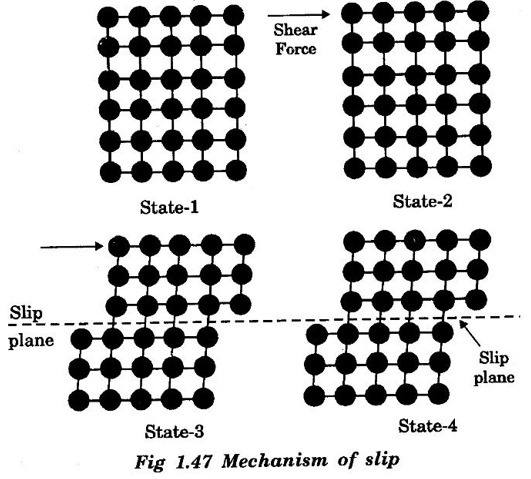
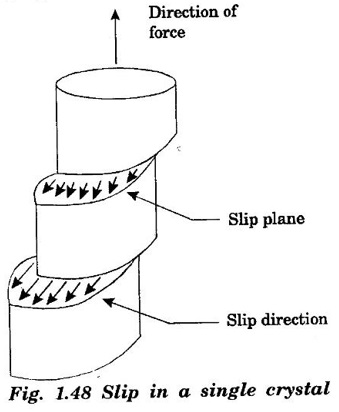
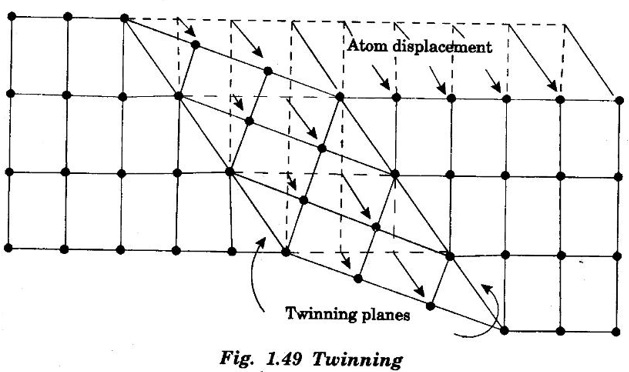
PLASTIC DEFORMATION MECHANISMS Plastic deformation of a single crystal occurs in two ways. They are (a) Slip (b) Twinning The deformation by slip takes place when one part of the crystal moves or glides over another part along certain planes. The planes over which slip takes place are the planes of greatest atomic density and they are called slip planes. Slip directions are the closest packed directions within the slip planes. There are 4 stages during plastic deformation of single crystal by the slip. (Fig. 1.47). Stage 1 → Perfect crystal without slip Stage 2 → Deforming shear force is applied to the crystal Stage 3 → Slip taking place along the slip plane Stage 4 → Permanent deformation when deforming forces are removed. The slip represents a displacement of a part of the crystal relative to another along certain crystallographic planes and in certain crystallographic directions. (Fig. 1.48) The particular crystallographic planes where slip occurs are called slip planes. Similarly, the preferable direction along which slip occurs is called the slip direction. Another important plastic deformation mechanism which occurs in some metal is known as 'twinning'. The mechanism of twinning is shown in fig.1.49. The shear forces produce atomic displacements such that the deformed lattice forms a mirror image of the undeformed lattice. That is, the atoms on one side of the plane location is in mirror image position of the atoms on the other side. The crystallographic plane of symmetry between the deformed and undeformed parts of the metal lattice is called the twinning plane. Twinning is a major deformation notably seen in hexagonal close packed (HCP) metals like zinc and tin. Twinning also occurs in definite crystallographic planes and direction that depends on the crystal structure. 1. Mechanical twins 2. Annealing twins. Twins which are produced by mechanical deformation are called mechanical twins. These twins are produced in BCC and HCP metals under the conditions of decreased temperature and shock loading. Mechanical twins are not formed in FCC metals. These twins can form in a few micro second time while slip takes several seconds to occur. The twins which are produced by annealing are called annealing twins. These are usually broader. Most of the FCC metals form annealing twins. They are formed because of a change in normal growth mechanism. Table 1.4Slip
Mechanism of slip
Twinning
Types of Twins
1. Mechanical twins
2. Annealing twins
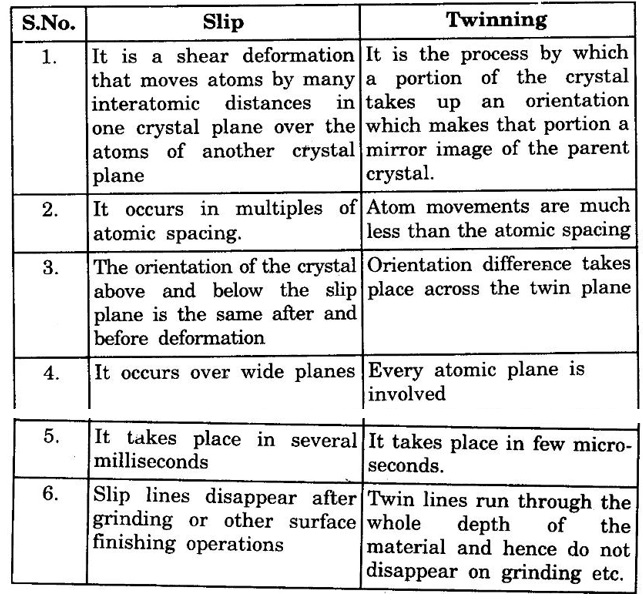
Comparison between slip and twinning
Materials Science: Unit I: Crystallography : Tag: : Types: Slip, Twinning - Plastic Deformation Mechanisms
Materials Science: Unit I: Crystallography
Under Subject
Materials Science
PH3251 2nd semester Mechanical Dept | 2021 Regulation | 2nd Semester Mechanical Dept 2021 Regulation
Related Subjects

Professional English II
HS3251 2nd Semester 2021 Regulation | 2nd Semester Common to all Dept 2021 Regulation
Statistics and Numerical Methods
MA3251 2nd Semester 2021 Regulation M2 Engineering Mathematics 2 | 2nd Semester Common to all Dept 2021 Regulation
Engineering Graphics
GE3251 eg 2nd semester | 2021 Regulation | 2nd Semester Common to all Dept 2021 Regulation
Physics for Electrical Engineering
PH3202 2nd Semester 2021 Regulation | 2nd Semester EEE Dept 2021 Regulation
Basic Civil and Mechanical Engineering
BE3255 2nd Semester 2021 Regulation | 2nd Semester EEE Dept 2021 Regulation
Electric Circuit Analysis
EE3251 2nd Semester 2021 Regulation | 2nd Semester EEE Dept 2021 Regulation
Physics for Electronics Engineering
PH3254 - Physics II - 2nd Semester - ECE Department - 2021 Regulation | 2nd Semester ECE Dept 2021 Regulation

Electrical and Instrumentation Engineering
BE3254 - 2nd Semester - ECE Dept - 2021 Regulation | 2nd Semester ECE Dept 2021 Regulation
Circuit Analysis
EC3251 - 2nd Semester - ECE Dept - 2021 Regulation | 2nd Semester ECE Dept 2021 Regulation
Materials Science
PH3251 2nd semester Mechanical Dept | 2021 Regulation | 2nd Semester Mechanical Dept 2021 Regulation
Basic Electrical and Electronics Engineering
BE3251 2nd semester Mechanical Dept | 2021 Regulation | 2nd Semester Mechanical Dept 2021 Regulation
Physics for Civil Engineering
PH3201 2021 Regulation | 2nd Semester Civil Dept 2021 Regulation

Basic Electrical, Electronics and Instrumentation Engineering
BE3252 2021 Regulation | 2nd Semester Civil Dept 2021 Regulation
Physics for Information Science
PH3256 2nd Semester CSE Dept | 2021 Regulation | 2nd Semester CSE Dept 2021 Regulation
Basic Electrical and Electronics Engineering
BE3251 2nd Semester CSE Dept 2021 | Regulation | 2nd Semester CSE Dept 2021 Regulation
Programming in C
CS3251 2nd Semester CSE Dept 2021 | Regulation | 2nd Semester CSE Dept 2021 Regulation