Materials Science: Unit I: Crystallography
Planes in Crystals
Definition, Procedure for finding Miller indices, Density of Crystal
A crystal lattice is considered as a collection of a set of parallel equidistant planes passing through lattice points. These planes are known as lattice planes.
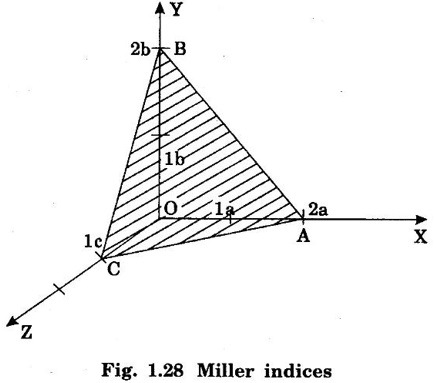
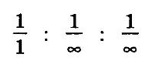
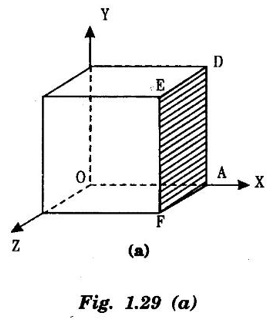
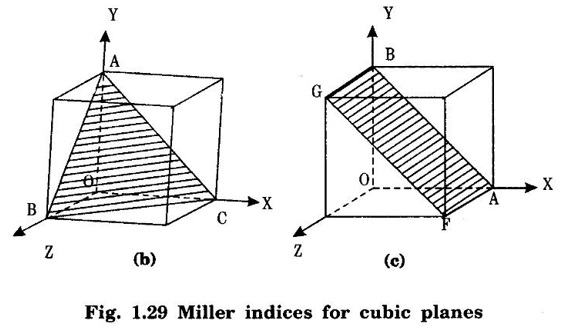
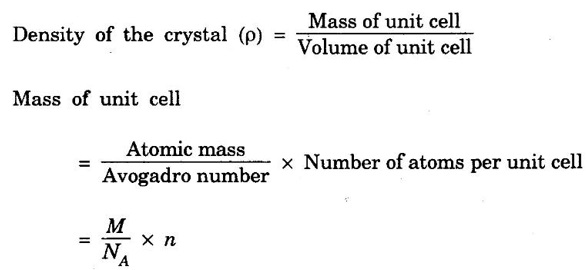
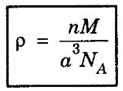
PLANES IN CRYSTALS A crystal lattice is considered as a collection of a set of parallel equidistant planes passing through lattice points. These planes are known as lattice planes. These sets of planes may be chosen in many different ways in the given lattice, for example (a), (b), (c), (d), etc. as in fig. 1.30. Now, the problem that may arise is how to designate (identify) a plane in a crystal. Miller introduced a set of three numbers to designate the orientation of a plane in a crystal. This set of three numbers is called Miller indices of the concerned plane. The orientation of a plane in a crystal is usually described in terms of their intercepts on the three axes. For example, a plane ABC in fig. 1.28 has intercepts of 2 axial units on X-axis, 2 axial units on Y-axis and 1 axial unit on Z-axis. In other words, the numerical parameters of this plane are 2, 2 and 1. Hence, its orientation is (2, 2, 1). Miller suggested that it is better to describe the orientation of a plane by the reciprocal of coefficient of intercepts (numerical paraments) These reciprocals are converted into whole numbers and they are known as Miller indices of the concerned plane. Hence, Miller indices of a plane ABC (fig. 1.31) are We understand that for getting the whole numbers, all three reciprocals of the co-efficients of intercepts are multiplied by 2 (LCM). It is noted that multiplying all numerical parameters by the same number does not change the orientation of a plane. The numbers for these planes are written within parentheses and not in brackets. The general expression for Miller indices of a plane is (h k l). The symbol for a family of parallel planes is <h k l >. Miller indices are the smallest possible three integers that have the same ratios as the reciprocals of the numerical parameters of the plane concerned on the three axes. Consider a crystal plane. Let us find its Miller indices as follows. While finding Miller indices of a cubic crystal plane, the following points should be kept in mind. (i) When a plane is parallel to one of the coordinate axes, it is said to meet that axis at infinity. Since 1/ ∞ = 0, Miller index for that axis is zero. (ii) When the intercept of a plane is on the negative part of any axis, Miller index is distinguished by a bar put directly over it. Consider a shaded plane in fig. 1.29 (a). This plane ADEF cuts X-axis at the point A and it is parallel to Y and Z axes. If the side of the cube is taken as one unit in length, then intercepts made by this plane on three axes are 1 : ∞ : ∞ The reciprocals of the intercepts are i.e., 1 : 0 : 0 Hence, Miller indices of this plane are (100). The plane ABC in fig. 1.29 (b) has equal intercepts on the three axes and hence its Miller indices are (111). Miller indices of the plane GBAF are (110) as shown in fig. 1.29 (c). This is defined as: n → number of atoms per unit cell and NA → Avogadro's number, M → the atomic weight and a → side of a cubic unit cell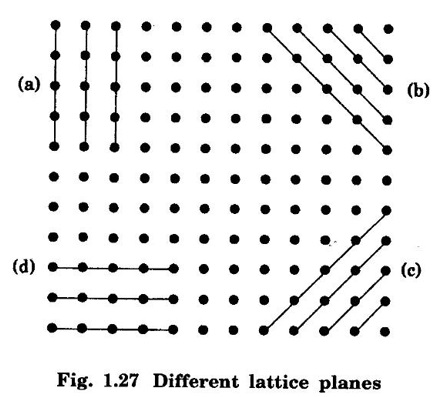
MILLER INDICES
Explanation
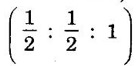 or simply (112).
Definition
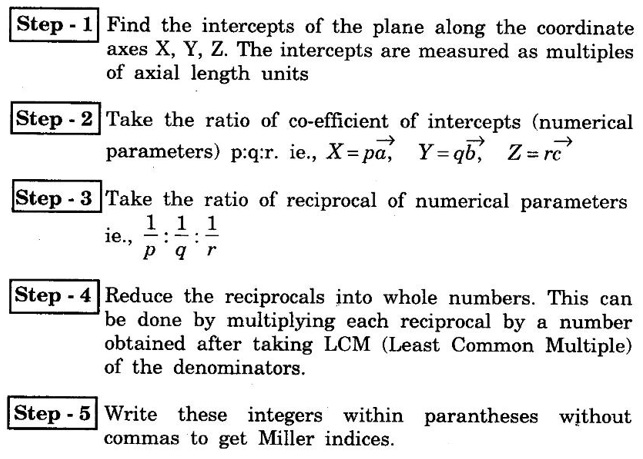
Procedure for finding Miller indices
Miller indices of cubic crystal planes
Density of Crystal
Materials Science: Unit I: Crystallography : Tag: : Definition, Procedure for finding Miller indices, Density of Crystal - Planes in Crystals
Materials Science: Unit I: Crystallography
Under Subject

Materials Science
PH3251 2nd semester Mechanical Dept | 2021 Regulation | 2nd Semester Mechanical Dept 2021 Regulation
Related Subjects

Professional English II
HS3251 2nd Semester 2021 Regulation | 2nd Semester Common to all Dept 2021 Regulation
Statistics and Numerical Methods
MA3251 2nd Semester 2021 Regulation M2 Engineering Mathematics 2 | 2nd Semester Common to all Dept 2021 Regulation
Engineering Graphics
GE3251 eg 2nd semester | 2021 Regulation | 2nd Semester Common to all Dept 2021 Regulation

Physics for Electrical Engineering
PH3202 2nd Semester 2021 Regulation | 2nd Semester EEE Dept 2021 Regulation

Basic Civil and Mechanical Engineering
BE3255 2nd Semester 2021 Regulation | 2nd Semester EEE Dept 2021 Regulation
Electric Circuit Analysis
EE3251 2nd Semester 2021 Regulation | 2nd Semester EEE Dept 2021 Regulation

Physics for Electronics Engineering
PH3254 - Physics II - 2nd Semester - ECE Department - 2021 Regulation | 2nd Semester ECE Dept 2021 Regulation

Electrical and Instrumentation Engineering
BE3254 - 2nd Semester - ECE Dept - 2021 Regulation | 2nd Semester ECE Dept 2021 Regulation
Circuit Analysis
EC3251 - 2nd Semester - ECE Dept - 2021 Regulation | 2nd Semester ECE Dept 2021 Regulation
Materials Science
PH3251 2nd semester Mechanical Dept | 2021 Regulation | 2nd Semester Mechanical Dept 2021 Regulation

Basic Electrical and Electronics Engineering
BE3251 2nd semester Mechanical Dept | 2021 Regulation | 2nd Semester Mechanical Dept 2021 Regulation

Physics for Civil Engineering
PH3201 2021 Regulation | 2nd Semester Civil Dept 2021 Regulation

Basic Electrical, Electronics and Instrumentation Engineering
BE3252 2021 Regulation | 2nd Semester Civil Dept 2021 Regulation

Physics for Information Science
PH3256 2nd Semester CSE Dept | 2021 Regulation | 2nd Semester CSE Dept 2021 Regulation

Basic Electrical and Electronics Engineering
BE3251 2nd Semester CSE Dept 2021 | Regulation | 2nd Semester CSE Dept 2021 Regulation
Programming in C
CS3251 2nd Semester CSE Dept 2021 | Regulation | 2nd Semester CSE Dept 2021 Regulation