Materials Science: Unit I: Crystallography
Burger's Vectors
Crystallography
The defects on the surface of material are called surface defects or plane defects. They are also known as two dimensional imperfections.
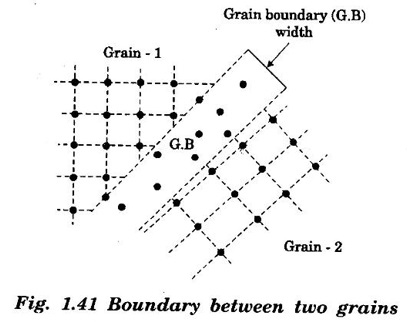
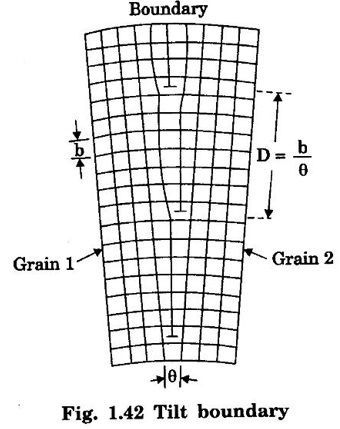
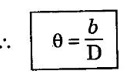
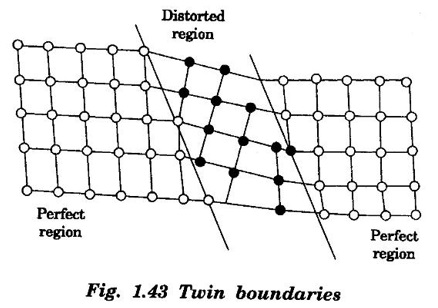
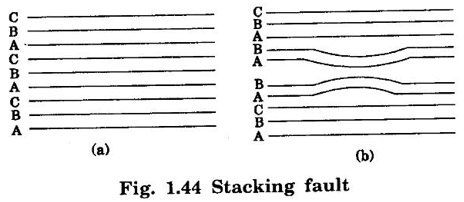
BURGER'S VECTORS The dislocation lines are expressed by a burger vector Consider a point starting from P in (fig. 1.39 (a)) which moves in a particular direction as shown and it completes atomic distances in the form of a circuit called "burger circuit" or "burger loop". If the same circuit is drawn starting from P in fig. (1.39 (b)) then the circuit would not complete, this is because of the presence of a dislocation. If we wish to arrive at starting point P from Q, then we must move an extra distance 'b' as shown in figure (b). The vector The defects on the surface of material are called surface defects or plane defects. They are also known as two dimensional imperfections. Surface defects are due to a change in the stacking of atomic planes on or across a boundary. Some important internal surface defects (i) Grain boundaries (ii) Tilt and twist boundaries (iii) Twin boundaries (iv) Stacking fault Whenever the grains of of different orientations separate the general pattern of atoms and exhibits a boundary, the defect caused is called grain boundary. (Fig. 1.41) A grain boundary is formed when two growing grain surfaces meet. The shape of the grain is usually influenced by the presence of surrounding grains. This type of defect generally takes place during the solidification of liquid metal. Tilt boundary is another surface imperfection. It is an array of parallel edge dislocations of same sign (i.e., either T or ⊥) arranged one above other in an array or series (figure 1.42.) Tilt boundary is a type of low angle boundary (i.e., less than 10°). By rotation of an axis in the boundary, it is possible to bring the axis of two bordering grains into coincidence, then Angle of tilt, tan θ = b / D D - Dislocation spacing b - Length of Burger's vector When θ is very small, then tan θ = 0 Twist boundaries are another type of low angle boundaries. It consists of atleast two sets of parallel screw dislocations lying in the boundary. In twist boundary, the rotation is about an axis normal to the boundary. Twin boundaries are another, surface imperfections. If the boundaries in which the atomic arrangement on one side of the boundary is somewhat a mirror image of the arrangement of atoms of the other side (fig. 1.43,). The defect caused is called twin boundary. Stacking Faults It is a kind surface imperfection. Whenever the stacking of atoms is not in proper sequence throughout the crystal, defect caused is called stacking fault. Explanation Fig. 1.44(a) shows the proper sequence of atomic planes if we read from bottom to top as A - B - C - A - B - C - A - B - C. But fig. 1.44 (b) shows the sequence of atomic planes as A - B - C – A - B - A - B - A - B - C. The region in which the stacking fault occurs (A - B - A - B) forms a thin region of a hexagonal close packing in a FCC crystal. It indicates the amount and direction of shift in lattice on slip plane. The figure 1.39 shows a perfect crystal and a crystal with a positive edge dislocation.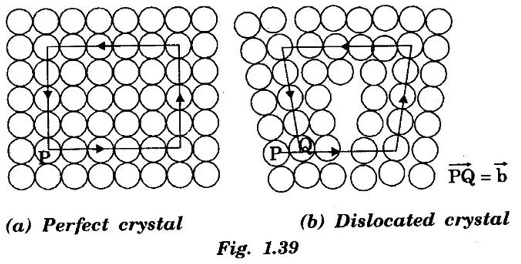
 connects end point with starting point. This is burger's vector of the dislocation.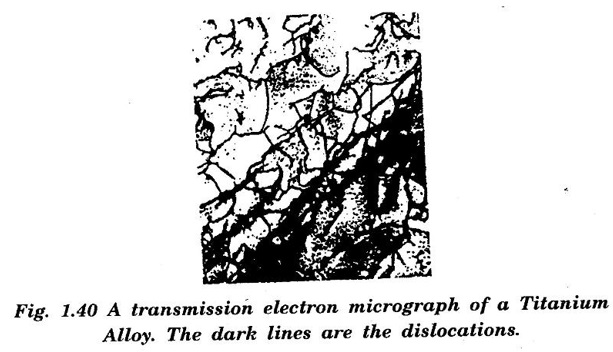
Surface Defects (Plane Defects)
(i) Grain boundaries
(ii) Tilt and twist boundaries
Twist boundaries
(iii) Twin boundaries
Materials Science: Unit I: Crystallography : Tag: : Crystallography - Burger's Vectors
Materials Science: Unit I: Crystallography
Under Subject
Materials Science
PH3251 2nd semester Mechanical Dept | 2021 Regulation | 2nd Semester Mechanical Dept 2021 Regulation
Related Subjects
Professional English II
HS3251 2nd Semester 2021 Regulation | 2nd Semester Common to all Dept 2021 Regulation
Statistics and Numerical Methods
MA3251 2nd Semester 2021 Regulation M2 Engineering Mathematics 2 | 2nd Semester Common to all Dept 2021 Regulation
Engineering Graphics
GE3251 eg 2nd semester | 2021 Regulation | 2nd Semester Common to all Dept 2021 Regulation
Physics for Electrical Engineering
PH3202 2nd Semester 2021 Regulation | 2nd Semester EEE Dept 2021 Regulation
Basic Civil and Mechanical Engineering
BE3255 2nd Semester 2021 Regulation | 2nd Semester EEE Dept 2021 Regulation
Electric Circuit Analysis
EE3251 2nd Semester 2021 Regulation | 2nd Semester EEE Dept 2021 Regulation
Physics for Electronics Engineering
PH3254 - Physics II - 2nd Semester - ECE Department - 2021 Regulation | 2nd Semester ECE Dept 2021 Regulation
Electrical and Instrumentation Engineering
BE3254 - 2nd Semester - ECE Dept - 2021 Regulation | 2nd Semester ECE Dept 2021 Regulation
Circuit Analysis
EC3251 - 2nd Semester - ECE Dept - 2021 Regulation | 2nd Semester ECE Dept 2021 Regulation
Materials Science
PH3251 2nd semester Mechanical Dept | 2021 Regulation | 2nd Semester Mechanical Dept 2021 Regulation
Basic Electrical and Electronics Engineering
BE3251 2nd semester Mechanical Dept | 2021 Regulation | 2nd Semester Mechanical Dept 2021 Regulation
Physics for Civil Engineering
PH3201 2021 Regulation | 2nd Semester Civil Dept 2021 Regulation

Basic Electrical, Electronics and Instrumentation Engineering
BE3252 2021 Regulation | 2nd Semester Civil Dept 2021 Regulation
Physics for Information Science
PH3256 2nd Semester CSE Dept | 2021 Regulation | 2nd Semester CSE Dept 2021 Regulation
Basic Electrical and Electronics Engineering
BE3251 2nd Semester CSE Dept 2021 | Regulation | 2nd Semester CSE Dept 2021 Regulation
Programming in C
CS3251 2nd Semester CSE Dept 2021 | Regulation | 2nd Semester CSE Dept 2021 Regulation