Materials Science: Unit III: Semiconductors and Transport Physics
Hall effect
Statement, Definition, Hall coefficient, Applications
The electrical conductivity measurements are not sufficient for the determination of number of charge carriers and their mobilities.
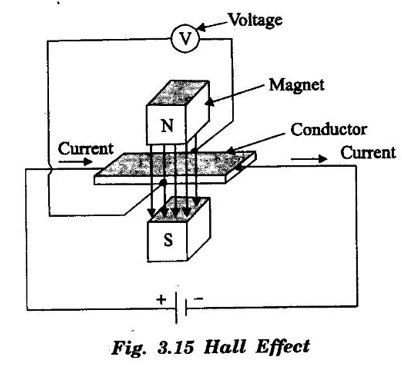
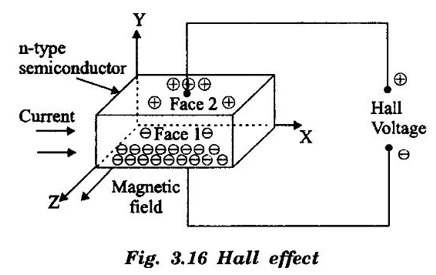
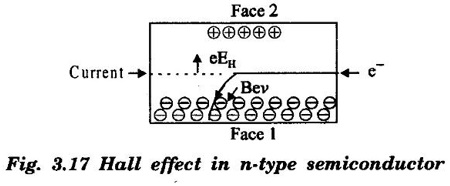
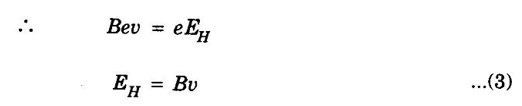
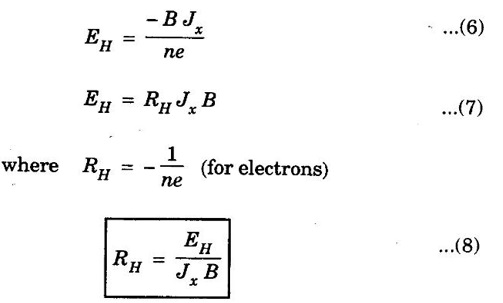
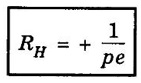
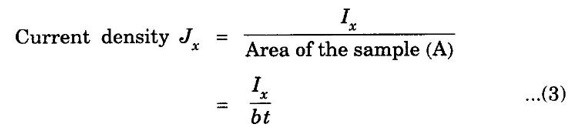
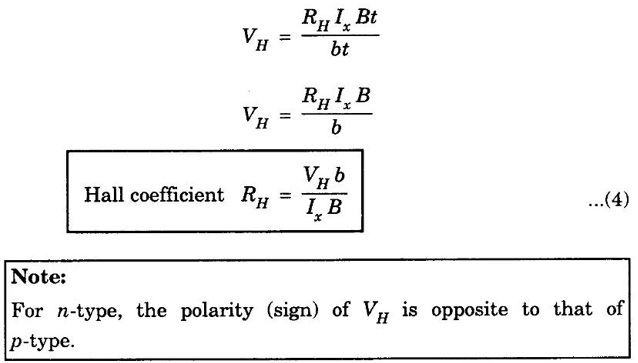
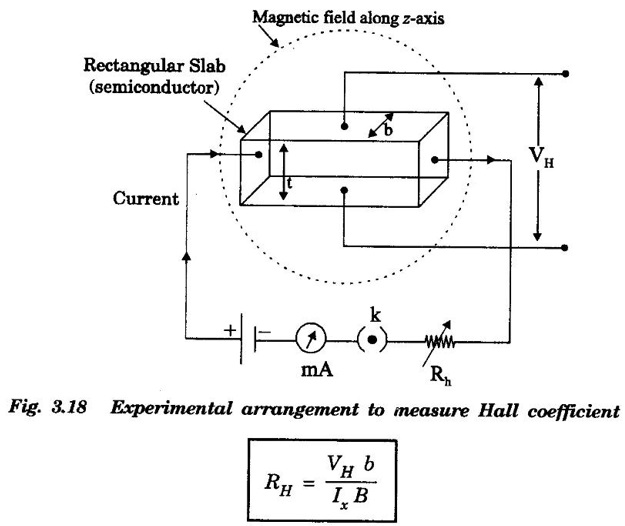
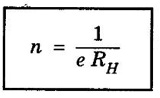
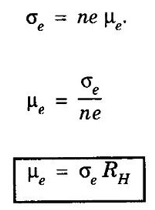
HALL EFFECT • The electrical conductivity measurements are not sufficient for the determination of number of charge carriers and their mobilities. • Moreover, these measurements do not indicate whether current conduction is due to electrons or holes. • Hence, it is very difficult to distinguish between p-type and electrical n-type semiconductors. Besides, the conductivity measurements do not give any information about the sign of the majority (p type or n type) charge carriers. • Therefore, Hall effect is used to distinguish between two types of charge carriers (electrons and hole). It also provides information about the sign of charge carriers. When a conductor carrying a current (I) is placed perpendicular to a magnetic field (B), a potential difference is produced inside the conductor in a direction perpendicular to both current and magnetic field. (Fig. 3.15) This phenomenon is known as Hall effect. The voltage thus generated is called Hall voltage. Consider a n-type semiconductor in the form of a rectangular slab. In this slab, the current flows in X - direction and magnetic field B is applied in Z-direction. Due to Hall effect, voltage is developed along Y- direction as shown in fig. 3.16. The current flow is entirely due to the flow of electrons moving from right to left along X-direction. When a magnetic field (B) is applied in Z-direction, then the electrons moving with velocity v experience a downward force. Downward force experienced by the electrons = Bev ….(1) This downward force deflects the electrons in downward direction. Hence, there is an accumulation of negative charge (electrons) on the bottom face of the slab (fig 3.17). It causes bottom face to be more negative with respect to top face. Now, a potential difference is developed between top and bottom faces of the slab. This potential difference produces an electric field EH in negative Y- direction. It is called Hall field. This electric field develops a force (Lorentz force). This force is acting in the upward direction on each electron. Upward force acting on each electron = eEH ….. (2) At equilibrium, downward force balances upward force. The current density (Jx) along X-direction is related to velocity v as where n is concentration electrons. Substituting eqn (5) in eqn (3), we have RH is a constant and it is known as Hall coefficient. The negative sign indicates that the electric field is developed in negative Y - direction. Similar to n-type semiconductor, we can write for p-type semiconductor Eн = RнJx B where Hall coefficient. where p is concentration of holes. The positive sign indicates that the electrical field (Hall field) is developed in positive Y - direction. If t is the thickness of the sample and VH is the voltage developed, then VH = Eн t where EH is Hall field. ...(1) VH = RHJx Bt ...(2) If b is breadth of the sample, then Cross sectional area of the sample (A) = Breadth (b) ×Thickness (t) = bt Substituting eqn (3) in eqn (2), we get The experimental arrangement to measure Hall-coefficient is shown in fig. 3.18. A semiconductor is taken in the form of a rectangular slab of thickness t and breadth b. A suitable current Ix ampere is passed into this sample along X-axis by connecting it to a battery. Now, it is placed in between north and south poles of an electromagnet. The magnetic field is applied along Z-axis. Due to Hall effect, Hall voltage (VH) is developed in the sample. This voltage is measured by fixing two probes at the centers of the bottom and top faces of the sample. By measuring Hall voltage, Hall coefficient is determined from the formula From Hall coefficient, carrier concentration and mobility can be determined. (i) Determination of semiconductor type The sign of the Hall coefficient is used to find whether a given semiconductor is n-type or p-type. (ii) Calculation of carrier concentration By measuring Hall coefficient RH, carrier concentration is determined from the relation (iii) Determination of mobility We know that electrical conductivity, Thus, by measuring electrical conductivity and Hall coefficient of a sample, the mobility of charge carriers can be calculated.Statement
Hall effect in n- type semiconductor


Hall effect in p-type semiconductor
Hall coefficient in terms of Hall voltage
Determination of Hall coefficient
Applications of Hall effect
Materials Science: Unit III: Semiconductors and Transport Physics : Tag: : Statement, Definition, Hall coefficient, Applications - Hall effect
Materials Science: Unit III: Semiconductors and Transport Physics
Under Subject

Materials Science
PH3251 2nd semester Mechanical Dept | 2021 Regulation | 2nd Semester Mechanical Dept 2021 Regulation
Related Subjects

Professional English II
HS3251 2nd Semester 2021 Regulation | 2nd Semester Common to all Dept 2021 Regulation

Statistics and Numerical Methods
MA3251 2nd Semester 2021 Regulation M2 Engineering Mathematics 2 | 2nd Semester Common to all Dept 2021 Regulation

Engineering Graphics
GE3251 eg 2nd semester | 2021 Regulation | 2nd Semester Common to all Dept 2021 Regulation

Physics for Electrical Engineering
PH3202 2nd Semester 2021 Regulation | 2nd Semester EEE Dept 2021 Regulation

Basic Civil and Mechanical Engineering
BE3255 2nd Semester 2021 Regulation | 2nd Semester EEE Dept 2021 Regulation
Electric Circuit Analysis
EE3251 2nd Semester 2021 Regulation | 2nd Semester EEE Dept 2021 Regulation

Physics for Electronics Engineering
PH3254 - Physics II - 2nd Semester - ECE Department - 2021 Regulation | 2nd Semester ECE Dept 2021 Regulation

Electrical and Instrumentation Engineering
BE3254 - 2nd Semester - ECE Dept - 2021 Regulation | 2nd Semester ECE Dept 2021 Regulation
Circuit Analysis
EC3251 - 2nd Semester - ECE Dept - 2021 Regulation | 2nd Semester ECE Dept 2021 Regulation
Materials Science
PH3251 2nd semester Mechanical Dept | 2021 Regulation | 2nd Semester Mechanical Dept 2021 Regulation

Basic Electrical and Electronics Engineering
BE3251 2nd semester Mechanical Dept | 2021 Regulation | 2nd Semester Mechanical Dept 2021 Regulation

Physics for Civil Engineering
PH3201 2021 Regulation | 2nd Semester Civil Dept 2021 Regulation

Basic Electrical, Electronics and Instrumentation Engineering
BE3252 2021 Regulation | 2nd Semester Civil Dept 2021 Regulation

Physics for Information Science
PH3256 2nd Semester CSE Dept | 2021 Regulation | 2nd Semester CSE Dept 2021 Regulation

Basic Electrical and Electronics Engineering
BE3251 2nd Semester CSE Dept 2021 | Regulation | 2nd Semester CSE Dept 2021 Regulation

Programming in C
CS3251 2nd Semester CSE Dept 2021 | Regulation | 2nd Semester CSE Dept 2021 Regulation