Basic Electrical and Electronics Engineering: Unit II: Electrical Machines
Types of D.C. Generators
D.C. Generators are classified on the basis of the method of exciting the field coils as 1. Separately excited DC generator 2. Self excited DC generator
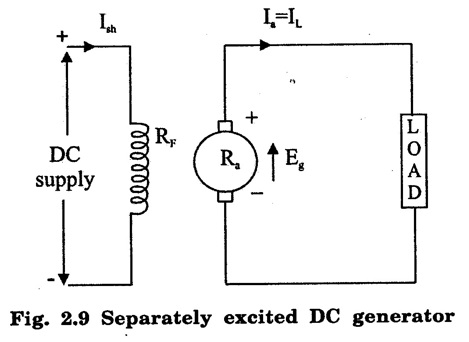
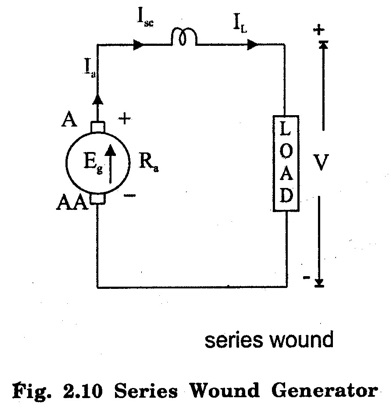
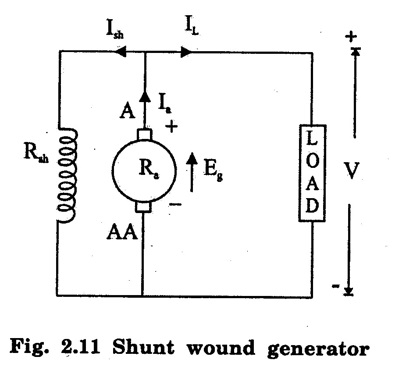
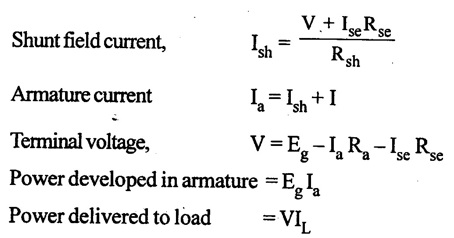
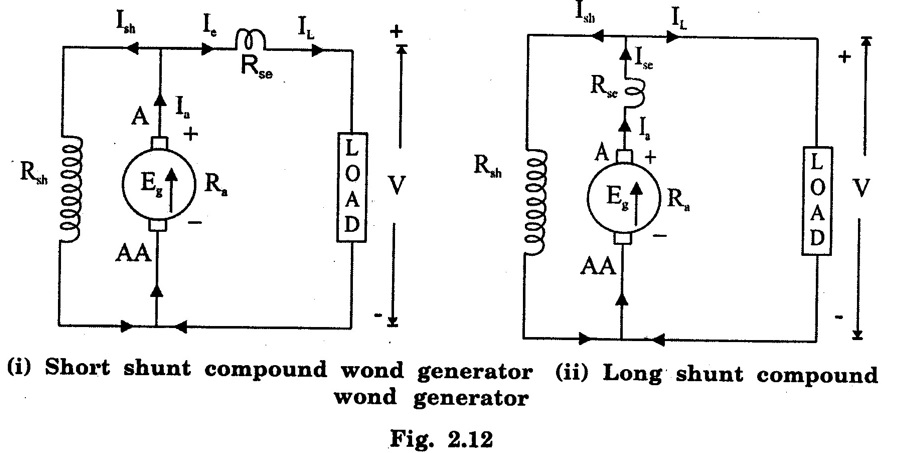
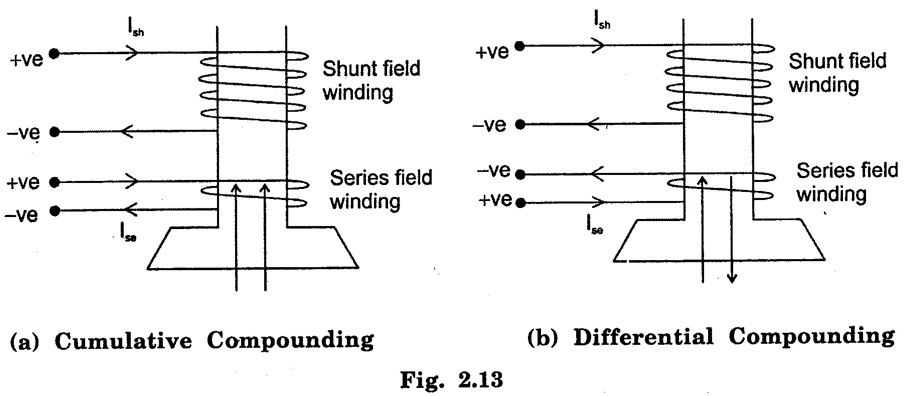
TYPES OF D.C. GENERATORS D.C. Generators are classified on the basis of the method of exciting the field coils as 1. Separately excited DC generator 2. Self excited DC generator Self excited DC generator can again be classified as 1) DC Series generator 2) DC Shunt generator and 3) DC Compound generator. In separately excited type, the field coils are excited from an independent D.C. source. Fig. 2.9 shows the connections of a separately excited generator. The voltage output depends upon the speed of rotation of armature and the field current (Eg =Pϕ ZN/60A). The greater the speed and field current, greater is the generated e.m.f. It may be noted that separately excited d.c. generators are rarely used in practice. The d.c. generators are normally of self-excited type. Armature current, Ia = IL Terminal voltage, V = Eg – Ia Ra Electric power developed = EgIa Power delivered to load = EgIa – Ia2 Ra = Ia (Eg − Ia Ra) = VIa Where, Ia = Armature current IL = Load current V = Terminal voltage Eg = Generated emf Ra = armature resistance In self excited type, excitation of the field coils are done by feeding back a part of the output of the generator. These are the generators whose field magnets are energized by the electric current supplied by themselves. In these type of machines field coils are internally connected with the armature. Due to residual magnetism some flux is always present in the poles. When the armature is rotated some emf is induced. Hence some induced electric current is produced. This small electric current flows through the field coil as well as the load and thereby strengthening the pole flux. As the pole flux strengthened, it will produce more armature emf, which cause further increase of electric current through the field. This increased field electric current further raises armature emf and this cumulative phenomenon continues until the excitation reaches to the rated value. There are three types of self-excited generators depending upon the manner in which the field winding is connected to the armature, namely; 1. Series wound generators 2. Shunt wound generators 3. Compound wound generators In these type of generators, the field coils are connected in series with armature conductors as shown in figure 2.10. So, whole electric current flows through the field coils as well as the load. As series field winding carries full load current they consists of relatively few turns of thick wire. The electrical resistance of series field winding is therefore very low (nearly 0.5Ω). Let, Rse = Series coil resistance Ise = Current flowing through the series field(series field current) Then, Ia = Ise = IL = I (say) Voltage across the load, V = Eg - I (Ra + Rse) – Vbrush where, Vbrush = brush drop Power generated, Pg = Eg × I Power delivered to the load, PL = V × I In these type of DC generators the field coils are connected in parallel with armature conductors as shown in figure 2.11. In shunt wound generators the voltage in the field winding is same as the voltage across the terminal. Let, Rsh = Shunt winding/coil resistance Ish = Current flowing through the shunt field Shunt field current, Ish = V/Rsh Armature current Ia = Ish + I Voltage across the load, V = Eg - Ia Ra Power generated, Pg = Eg × Ia Power delivered to the load, PL = V × IL It is a combination of few series and a few shunt windings and it may be either short shunt or long shunt. (a) Short Shunt compound wound in which armature and shunt field winding are connected in parallel and series field windings are connected in series with this combination. Series field current, Ise = IL (b) Long Shunt compound wound in which the armature and the series field coils are connected in series and the shunt field circuit is connected in parallel with this combination. Series field current, Ise = Ia = IL + Ish Shunt field current, Ish = V/Rsh Terminal voltage, V = Eg - Ia (Ra + Rse) Power developed in armature = Eg Ia Power delivered to load = VIL In a compound wound generator, the shunt field is stronger than the series field. When the series field assists the shunt field, generator is said to be commutatively compound wound. On the other hand if series field opposes the shunt field, the generator is said to be differentially compound wound.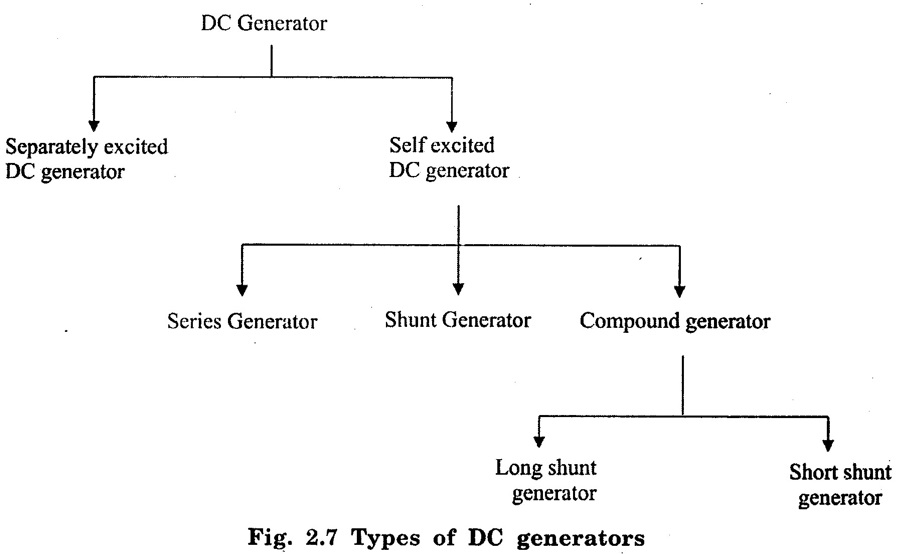
1. Separately excited DC generator
2. Self excited DC generator
1. Series Wound Generator
2. Shunt wound generators
3. Compound wound Generator
Basic Electrical and Electronics Engineering: Unit II: Electrical Machines : Tag: : - Types of D.C. Generators
Basic Electrical and Electronics Engineering: Unit II: Electrical Machines
Under Subject
Basic Electrical and Electronics Engineering
BE3251 2nd semester Mechanical Dept | 2021 Regulation | 2nd Semester Mechanical Dept 2021 Regulation
Basic Electrical and Electronics Engineering
BE3251 2nd Semester CSE Dept 2021 | Regulation | 2nd Semester CSE Dept 2021 Regulation
Basic Electrical and Electronics Engineering
EE25C01 2nd Semester | 2025 Regulation | 2nd Semester 2025 Regulation
Related Subjects
Professional English II
HS3251 2nd Semester 2021 Regulation | 2nd Semester Common to all Dept 2021 Regulation
Statistics and Numerical Methods
MA3251 2nd Semester 2021 Regulation M2 Engineering Mathematics 2 | 2nd Semester Common to all Dept 2021 Regulation
Engineering Graphics
GE3251 eg 2nd semester | 2021 Regulation | 2nd Semester Common to all Dept 2021 Regulation
Physics for Electrical Engineering
PH3202 2nd Semester 2021 Regulation | 2nd Semester EEE Dept 2021 Regulation
Basic Civil and Mechanical Engineering
BE3255 2nd Semester 2021 Regulation | 2nd Semester EEE Dept 2021 Regulation
Electric Circuit Analysis
EE3251 2nd Semester 2021 Regulation | 2nd Semester EEE Dept 2021 Regulation
Physics for Electronics Engineering
PH3254 - Physics II - 2nd Semester - ECE Department - 2021 Regulation | 2nd Semester ECE Dept 2021 Regulation
Electrical and Instrumentation Engineering
BE3254 - 2nd Semester - ECE Dept - 2021 Regulation | 2nd Semester ECE Dept 2021 Regulation
Circuit Analysis
EC3251 - 2nd Semester - ECE Dept - 2021 Regulation | 2nd Semester ECE Dept 2021 Regulation
Materials Science
PH3251 2nd semester Mechanical Dept | 2021 Regulation | 2nd Semester Mechanical Dept 2021 Regulation
Basic Electrical and Electronics Engineering
BE3251 2nd semester Mechanical Dept | 2021 Regulation | 2nd Semester Mechanical Dept 2021 Regulation
Physics for Civil Engineering
PH3201 2021 Regulation | 2nd Semester Civil Dept 2021 Regulation
Basic Electrical, Electronics and Instrumentation Engineering
BE3252 2021 Regulation | 2nd Semester Civil Dept 2021 Regulation
Physics for Information Science
PH3256 2nd Semester CSE Dept | 2021 Regulation | 2nd Semester CSE Dept 2021 Regulation
Basic Electrical and Electronics Engineering
BE3251 2nd Semester CSE Dept 2021 | Regulation | 2nd Semester CSE Dept 2021 Regulation
Programming in C
CS3251 2nd Semester CSE Dept 2021 | Regulation | 2nd Semester CSE Dept 2021 Regulation