Materials Science: Unit II(a): Electrical Properties of Materials
Tunneling
Electrical Properties of Materials
According to classical ideas, a particle striking a hard wall has no chance of leaking through it.
TUNNELING • According to classical ideas, a particle striking a hard wall has no chance of leaking through it. But, the behaviour of a quantum particle is different due to the wave nature associated with it. • We know that when an electromagnetic wave strikes at the interface of two media, it is partly reflected and partly transmitted through he interface and enters the second medium. • In a similar way the de Broglie wave also has a possibility of getting partly reflected from the boundary of the potential well and partly penetrating through the barrier. • Fig. 2.9 shows a particle with energy E < V approaching potential barrier of height V. • An electron of total energy E approaches the barrier from the left. From the view-point of classical physics, the electron would be reflected from the barrier because its energy E is less than V. • For the particle to overcome the potential barrier, it must have an energy equal to or greater than V. Quantum mechanics leads to an entirely new result. It shows that there is a finite chance for the electron to leak to the other side of the barrier. It is noted that the electron tunneled through the potential barrier and hence in quantum mechanics, this phenomenon is called tunneling. The transmission of electrons through the barrier is known as barrier penetration.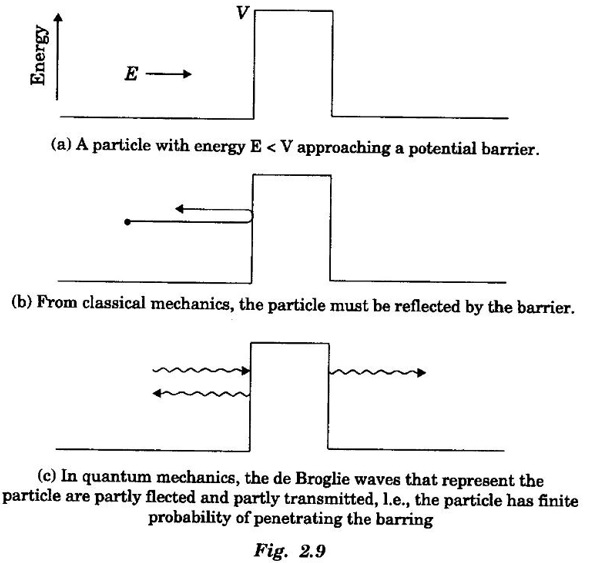
Materials Science: Unit II(a): Electrical Properties of Materials : Tag: : Electrical Properties of Materials - Tunneling
Materials Science: Unit II(a): Electrical Properties of Materials
Under Subject
Materials Science
PH3251 2nd semester Mechanical Dept | 2021 Regulation | 2nd Semester Mechanical Dept 2021 Regulation
Related Subjects
Professional English II
HS3251 2nd Semester 2021 Regulation | 2nd Semester Common to all Dept 2021 Regulation
Statistics and Numerical Methods
MA3251 2nd Semester 2021 Regulation M2 Engineering Mathematics 2 | 2nd Semester Common to all Dept 2021 Regulation
Engineering Graphics
GE3251 eg 2nd semester | 2021 Regulation | 2nd Semester Common to all Dept 2021 Regulation
Physics for Electrical Engineering
PH3202 2nd Semester 2021 Regulation | 2nd Semester EEE Dept 2021 Regulation
Basic Civil and Mechanical Engineering
BE3255 2nd Semester 2021 Regulation | 2nd Semester EEE Dept 2021 Regulation
Electric Circuit Analysis
EE3251 2nd Semester 2021 Regulation | 2nd Semester EEE Dept 2021 Regulation
Physics for Electronics Engineering
PH3254 - Physics II - 2nd Semester - ECE Department - 2021 Regulation | 2nd Semester ECE Dept 2021 Regulation
Electrical and Instrumentation Engineering
BE3254 - 2nd Semester - ECE Dept - 2021 Regulation | 2nd Semester ECE Dept 2021 Regulation
Circuit Analysis
EC3251 - 2nd Semester - ECE Dept - 2021 Regulation | 2nd Semester ECE Dept 2021 Regulation
Materials Science
PH3251 2nd semester Mechanical Dept | 2021 Regulation | 2nd Semester Mechanical Dept 2021 Regulation
Basic Electrical and Electronics Engineering
BE3251 2nd semester Mechanical Dept | 2021 Regulation | 2nd Semester Mechanical Dept 2021 Regulation
Physics for Civil Engineering
PH3201 2021 Regulation | 2nd Semester Civil Dept 2021 Regulation

Basic Electrical, Electronics and Instrumentation Engineering
BE3252 2021 Regulation | 2nd Semester Civil Dept 2021 Regulation
Physics for Information Science
PH3256 2nd Semester CSE Dept | 2021 Regulation | 2nd Semester CSE Dept 2021 Regulation

Basic Electrical and Electronics Engineering
BE3251 2nd Semester CSE Dept 2021 | Regulation | 2nd Semester CSE Dept 2021 Regulation
Programming in C
CS3251 2nd Semester CSE Dept 2021 | Regulation | 2nd Semester CSE Dept 2021 Regulation