Engineering Graphics: Unit I (e): Introduction to Systems of Projection
Systems of Projection
Types: Parallel and Perspective projection
The systems of projection are classified based on the direction in which the rays of sight are taken to the picture plane (drawing sheet).
SYSTEMS OF PROJECTION The systems of projection are classified based on the direction in which the rays of sight are taken to the picture plane (drawing sheet). Based on that a projection is mainly classified into two types (i) Parallel projection and (ii) Perspective (or Central projection). Parallel projection and perspective projection are further classified as detailed below: If the rays of sight (projectors) are parallel, the projection obtained is known as parallel projection. Parallel projection is further classified into two types (i) Orthographic projection and (ii) Oblique projection. In orthographic projection, projectors are parallel to each other and perpendicular to the picture plane, where as in oblique projection, the projectors are parallel to each other but make an angle, other than 90° to the picture plane. Orthographic projection is further classified into (i) Multiview projection and (ii) Axonometric projection. Multiview Projection In multiview orthographic projection the exact shape of an object is represented by two or more separate views projected on planes that are usually perpendicular to each other. Each view shows the shape of the object for a particular view direction and these views altogether describe the object completely. Hence this method of projection is most widely used in preparing engineering drawings. Multiview projections are classified into two groups as (i) First angle projection and (ii) Third angle projection. Multiview orthographic projection is explained in detail in Chapter 9. Axonometric Projection A single pictorial view which is obtained by viewing an object after turning it to get a view of its three faces simultaneously is called as Axonometric projection. Axonometric projection is a pictorial orthographic projection in which the image of an object is projected only on one picture plane. Axonometric projection is further classified into three groups as (i) Isometric projection, (ii) Dimetric projection and (iii) Trimetric projection. Among three types of Axonometric projection, Isometric projection is most commonly used since it is simple to draw and read. Isometric projection is explained in detail in Chapter 17. Perspective projection is a geometric method of projection by which an image of an object is projected upon a vertical plane, called picture plane in a similar way as in photography. In perspective projection, the projectors are converging and they intersect at a common point, called station point. Perspective projection is further classified into three groups as (i) One point perspective (ii) Two point perspective and (iii) Three point perspective. Perspective projection is explained in detail in Chapter 18. Among the various systems of projection, other than the orthographic multiview projections, all the projections are called as pictorial views. In pictorial view, a single view is drawn indicating all the three sides of the object, where as in orthographic multiview projection, the object shape is represented by two or more views. For pictorial view, Isometric views are generally used.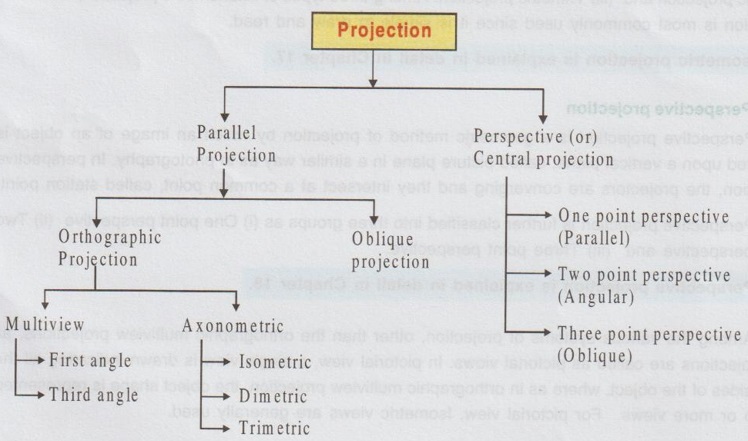
1. Parallel projection
2. Perspective projection
Engineering Graphics: Unit I (e): Introduction to Systems of Projection : Tag: : Types: Parallel and Perspective projection - Systems of Projection
Engineering Graphics: Unit I (e): Introduction to Systems of Projection
Under Subject
Engineering Graphics
GE3251 eg 2nd semester | 2021 Regulation | 2nd Semester Common to all Dept 2021 Regulation
NONO Engineering Drawing
ME25C01 EEE, Mech, Agri, EEE Depts | 2025 Regulation | 1st, 2nd Semester 2025 Regulation
Engineering Drawing
ME25C01 EEE, Mech, Agri, EEE Depts | 2025 Regulation | 1st, 2nd Semester 2025 Regulation
Related Subjects

Professional English II
HS3251 2nd Semester 2021 Regulation | 2nd Semester Common to all Dept 2021 Regulation
Statistics and Numerical Methods
MA3251 2nd Semester 2021 Regulation M2 Engineering Mathematics 2 | 2nd Semester Common to all Dept 2021 Regulation
Engineering Graphics
GE3251 eg 2nd semester | 2021 Regulation | 2nd Semester Common to all Dept 2021 Regulation
Physics for Electrical Engineering
PH3202 2nd Semester 2021 Regulation | 2nd Semester EEE Dept 2021 Regulation
Basic Civil and Mechanical Engineering
BE3255 2nd Semester 2021 Regulation | 2nd Semester EEE Dept 2021 Regulation
Electric Circuit Analysis
EE3251 2nd Semester 2021 Regulation | 2nd Semester EEE Dept 2021 Regulation
Physics for Electronics Engineering
PH3254 - Physics II - 2nd Semester - ECE Department - 2021 Regulation | 2nd Semester ECE Dept 2021 Regulation
Electrical and Instrumentation Engineering
BE3254 - 2nd Semester - ECE Dept - 2021 Regulation | 2nd Semester ECE Dept 2021 Regulation
Circuit Analysis
EC3251 - 2nd Semester - ECE Dept - 2021 Regulation | 2nd Semester ECE Dept 2021 Regulation
Materials Science
PH3251 2nd semester Mechanical Dept | 2021 Regulation | 2nd Semester Mechanical Dept 2021 Regulation
Basic Electrical and Electronics Engineering
BE3251 2nd semester Mechanical Dept | 2021 Regulation | 2nd Semester Mechanical Dept 2021 Regulation
Physics for Civil Engineering
PH3201 2021 Regulation | 2nd Semester Civil Dept 2021 Regulation
Basic Electrical, Electronics and Instrumentation Engineering
BE3252 2021 Regulation | 2nd Semester Civil Dept 2021 Regulation
Physics for Information Science
PH3256 2nd Semester CSE Dept | 2021 Regulation | 2nd Semester CSE Dept 2021 Regulation
Basic Electrical and Electronics Engineering
BE3251 2nd Semester CSE Dept 2021 | Regulation | 2nd Semester CSE Dept 2021 Regulation
Programming in C
CS3251 2nd Semester CSE Dept 2021 | Regulation | 2nd Semester CSE Dept 2021 Regulation