Engineering Materials and Metallurgy: Unit V: Mechanical Properties And Testing
Shear Tests
Procedure, Formula | Mechanical Test of Metal
There are two main types of test which may be used for the determination of the properties of a material in shear.
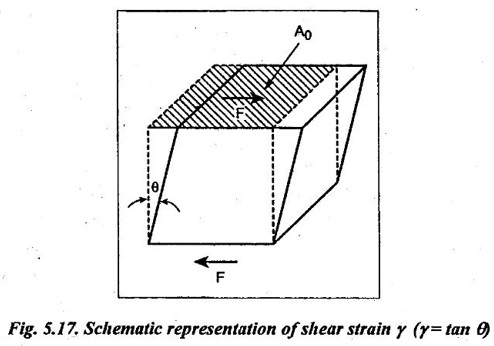
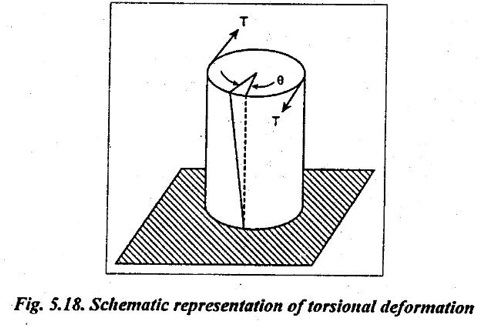
SHEAR TESTS ✔ There are two main types of test which may be used for the determination of the properties of a material in shear. They are : 1. Test performed using a pure shear force↑, and 2. Test performed using the application of a torque to a cylindrical specimen i.e., torsion test. † Shear force simply means a tangential force. ✔ Fig.5.17 illustrates the shear test, performed using a pure shear force. In this type, the force is imposed parallel to the upper and lower faces of the body. ✔ Shear stress: The shear stress or shear strength is the value of load applied tangentially to shear it off across the resisting section. Mathematically, Shear stress,τ = F / Ao ….. (5.13) where F = Shear force applied, and Ao = Area of shear (as shown in Fig.5.17) ✔ Shear strain: The shear strain is defined as the tangent of the strain angle 0, as indicated in Fig.5.17. Mathematically, shear strain, γ = tan θ ✔ Three main systems used for shear tests are: (i) Double shear system for round bar test-pieces using a fork and eye device; (ii) Double knife shear system for specimens with a rectangular section; and (iii) The shearing of a disc from sheet materials using a punch and die. ✓ The test equipment generally takes the form of attachments which can be used in conjunction with a universal testing machine. ✓ The disadvantages of these methods are: ■ Always there will be bending of the test-piece, therefore the stresses within the material will not be of the pure shear type, but they include bending stresses. ■ Very difficult to obtain accurate quantitative data from them. ✓ Torsion is a variation of pure shear, wherein a structural member is twisted in the manner of Fig.5.18. ✓ Torsional forces produce a rotational motion about the longitudinal axis of one end of the member relative to the other end. ✓ To determine the shear strength t, the following general torsion equation can be applied within the elastic range : where τ = Shear stress r = Radius of the cylinder, T = Applied torque, J = Second polar moment of area, G = Modulus of rigidity of the material, θ = Angle of twist in radians, and L = Gauge length of the test-piece.1. Shear Test Using a Pure Shear Force
1. Testing Methods
2. Torsion Test

Engineering Materials and Metallurgy: Unit V: Mechanical Properties And Testing : Tag: : Procedure, Formula | Mechanical Test of Metal - Shear Tests
Engineering Materials and Metallurgy: Unit V: Mechanical Properties And Testing
Under Subject

Engineering Materials and Metallurgy
ME3392 3rd semester Mechanical Dept | 2021 Regulation | 3rd Semester Mechanical Dept 2021 Regulation

Metallurgy and Materials Science
ME25C08 3rd Semester MECH Dept | 2025 Regulation | 3rd Semester 2025 Regulation
Related Subjects
Transforms and Partial Differential Equations
MA3351 3rd semester civil, Mechanical Dept | 2021 Regulation | 3rd Semester Mechanical Dept 2021 Regulation

Engineering Mechanics
ME3351 3rd semester civil, Mechanical Dept | 2021 Regulation | 3rd Semester Mechanical Dept 2021 Regulation
Engineering Thermodynamics
ME3391 3rd semester Mechanical Dept | 2021 Regulation | 3rd Semester Mechanical Dept 2021 Regulation

Fluid Mechanics and Machinery
CE3391 3rd semester Mechanical Dept | 2021 Regulation | 3rd Semester Mechanical Dept 2021 Regulation
Engineering Materials and Metallurgy
ME3392 3rd semester Mechanical Dept | 2021 Regulation | 3rd Semester Mechanical Dept 2021 Regulation

Manufacturing Processes
ME3393 3rd semester Mechanical Dept | 2021 Regulation | 3rd Semester Mechanical Dept 2021 Regulation