Hydraulics and Pneumatics: Unit II: Hydraulic Actuators and Control Components
review and summary
Hydraulic Actuators and Control Components - Hydraulics and Pneumatics
The actuators are the devices used for converting hydraulic energy into mechanical energy, and therefore have a function opposite to that of pumps.
REVIEW AND SUMMARY • The actuators are the devices used for converting hydraulic energy into mechanical energy, and therefore have a function opposite to that of pumps.' • Types of hydraulic actuators: Based on the type of motion actuators produce, they are categorized into : 1. Linear actuators (also called 'hydraulic cylinders'), and 2. Rotary actuators (also called 'hydraulic motors'). (a) Continuous rotary actuators, and (b) Limited-rotation rotary actuators. • The hydraulic actuators can be used for lifting, tilting, clamping, opening, closing, metering, mixing, turning, swinging, counter balancing, bending, and for many other operations. • The hydraulic cylinder is a device that converts fluid power into linear mechanical force and motion. • The important types of hydraulic cylinders are : 1. Single-acting cylinders, 2. Double-acting cylinders, 3. Telescopic cylinders, 4. Tandem cylinders, 5. Dual linear cylinders, and 6. Through rod cylinders. • The construction, working, advantages, disadvantages, applications and ranges of the above-mentioned hydraulic cylinders have been discussed in this chapter. • The function of a rotary actuator (also known as hydraulic motor) is to convert hydraulic energy into rotary mechanical energy. • The hydraulic motors are very much identical in construction and size to rotary type pumps. They work on exactly the reverse principle to that of rotating pumps. • Types of hydraulic motors: The hydraulic motors can be classified based on their degree of angular movement as : 1. Continuous rotary hydraulic motors, and (a) Gear motors, (b) Vane motors, and (c) Piston motors. 2. Limited-rotation hydraulic motors. (a) Vane type, and (b) Piston type. • Formulae Summary: For double-acting cylinders: For single-vane type limited-rotation motor : For hydraulic motors : Actuators Hydraulic actuators Linear actuator Hydraulic cylinders Single-acting cylinders Double-acting cylinders Differential cylinders Telescopic cylinders Tandem cylinders Dual linear cylinders Through rod cylinders Double-rod cylinders Cylinder cushioning Rotary actuators Hydraulic motors Continuous rotary hydraulic motors Gear motors Vane motors Piston motors Axial-piston motors Radial-piston motors Limited-rotation hydraulic motors Vane type Hydraulic motor performance Volumetric efficiency Mechanical efficiency Overall efficiency Hydraulic power Brake power Hydraulic motor performance curves Fluid transmission device Piston type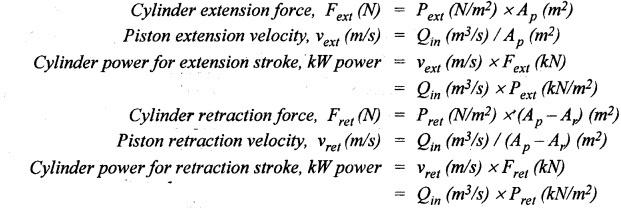


KEY TERMS ONE SHOULD REMEMBER
Hydraulics and Pneumatics: Unit II: Hydraulic Actuators and Control Components : Tag: : Hydraulic Actuators and Control Components - Hydraulics and Pneumatics - review and summary
Hydraulics and Pneumatics: Unit II: Hydraulic Actuators and Control Components
Under Subject
Hydraulics and Pneumatics
ME3492 4th semester Mechanical Dept | 2021 Regulation | 4th Semester Mechanical Dept 2021 Regulation
Related Subjects

Environmental Sciences and Sustainability
GE3451 ESS 4th Semester | 2021 Regulation | 4th Semester EEE Dept 2021 Regulation
Theory of Machines
ME3491 4th semester Mechanical Dept | 2021 Regulation | 4th Semester Mechanical Dept 2021 Regulation
Thermal Engineering
ME3451 4th semester Mechanical Dept | 2021 Regulation | 4th Semester Mechanical Dept 2021 Regulation
Hydraulics and Pneumatics
ME3492 4th semester Mechanical Dept | 2021 Regulation | 4th Semester Mechanical Dept 2021 Regulation
Manufacturing Technology
ME3493 4th semester Mechanical Dept | 2021 Regulation | 4th Semester Mechanical Dept 2021 Regulation
Strength of Materials
CE3491 4th semester Mechanical Dept | 2021 Regulation | 4th Semester Mechanical Dept 2021 Regulation