Engineering Graphics: Unit III (b): Projections of Solids
Classification of Solids
Engineering Graphics (EG)
Solids are classified according to the surface of covering and number of faces as detailed below.
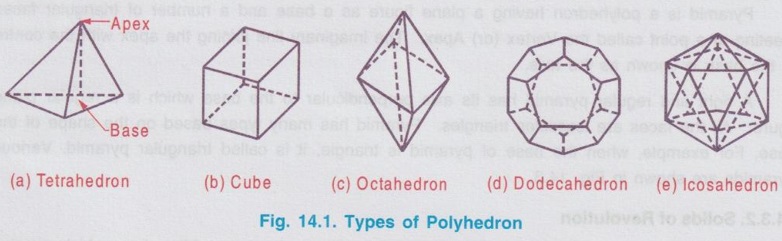
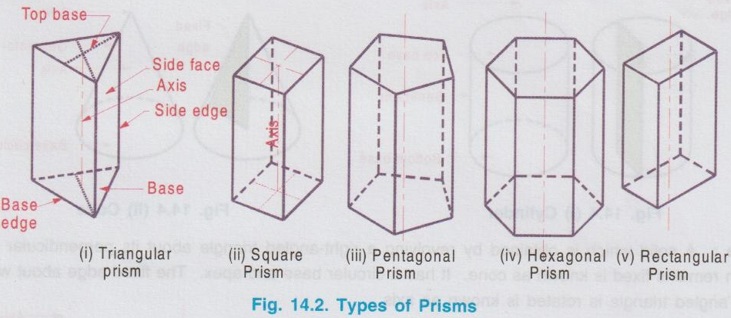
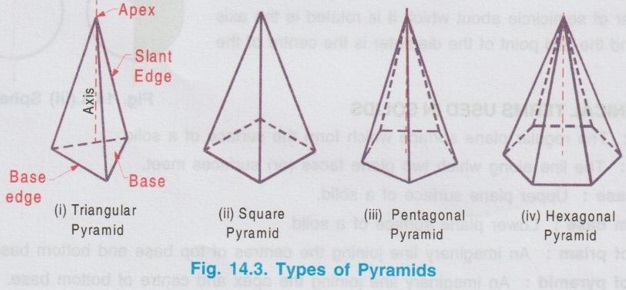
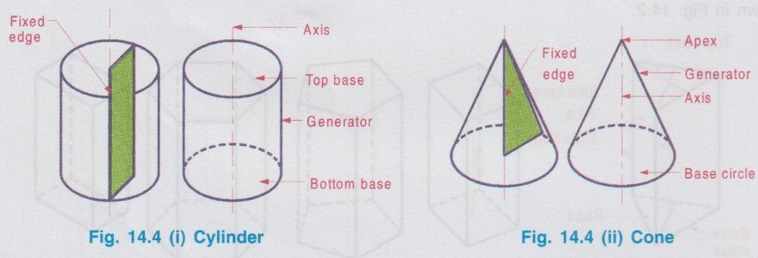
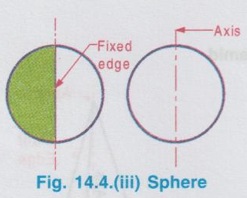
CLASSIFICATION OF SOLIDS Solids are classified according to the surface of covering and number of faces as detailed below. Solids are basically classified into Right solid and oblique solid. If the axis of a solid is perpendicular to its base it is called a right solid, otherwise it is called oblique solid. Right solid is further classified into two types according to the surface bounded, as polyhedron and solids of revolution. A solid bounded by plane surfaces which meet in straight lines called edges is called polyhedron. A solid obtained by revolving a plane figure about an edge which remains fixed is known as solid of Revolution. Polyhedron is further classified into three types as (i) Regular polyhedron (ii) Prism and (iii) Pyramid. Regular Polyhedron Regular polyhedron is a polyhedron having all the faces equal and regular. It has five types based on the number and shape of faces enclosed. Tetrahedron is a polyhedron having four equal equilateral triangular faces. Cube is a polyhedron having six equal square faces. Octahedron is a polyhedron having eight equal equilateral triangular faces. Dodecahedron is a polyhedron having twele equal pentagonal faces. Icosahedron is a polyhedron having twenty equal equilateral triangular faces. Prism Prism is a polyhedron having two equal and similar regular polygons called its ends or bases, parallel to each other and joined by other faces which are rectangles. The imaginary line joining the centres of the bases is called the axis. Prism is bound by rectangular surfaces on the sides, which join end surfaces. Prism has many types based on the number of rectangular surfaces enclosed. For example, when the base of prism is a rectangle it is called rectangular prism. Various prisms are shown in Fig. 14.2. Pyramid Pyramid is a polyhedron having a plane figure as a base and a number of triangular faces meeting at a point called the Vertex (or) Apex. The imaginary line joining the apex with the centre of the base is known as the axis. A right and regular pyramid has its axis perpendicular to the base which is a regular plane figure. All the faces are isosceles triangles. Pyramid has many types based on the shape of the base. For example, when the base of pyramid is triangle, it is called triangular pyramid. Various pyramids are shown in Fig. 14.3. The solids which are obtained by revolving a plane figure about one of its edges, which remains fixed are known as solids of revolution. Examples: Cylinder, Cone, Sphere etc., Cylinder: A solid which is generated by the revolution of a rectangle about one of its sides which is fixed is known as cylinder. The fixed edge about which rectangle is rotated is the axis of cylinder. It has two circular faces, top face and bottom base. Cone: A solid which is obtained by revolving a right-angled triangle about its perpendicular side which remains fixed is known as cone. It has a circular base and apex. The fixed edge about which right angled triangle is rotated is known as axis. Sphere: A solid which is obtained by revolving a semi-circle about its diameter which remains fixed is known as sphere. The diameter of semicircle about which it is rotated is the axis of sphere and the mid point of the diameter is the centre of the sphere.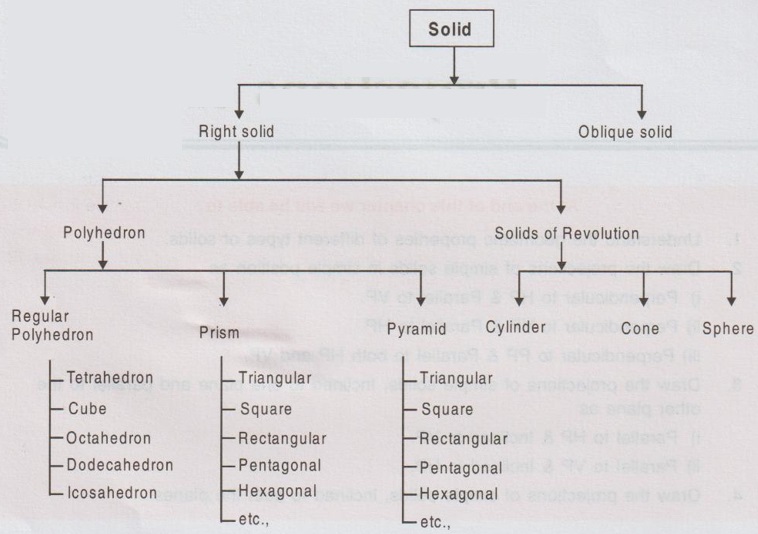
1. Types of Polyhedron
2. Solids of Revolution
Engineering Graphics: Unit III (b): Projections of Solids : Tag: : Engineering Graphics (EG) - Classification of Solids
Engineering Graphics: Unit III (b): Projections of Solids
Under Subject
Engineering Graphics
GE3251 eg 2nd semester | 2021 Regulation | 2nd Semester Common to all Dept 2021 Regulation
NONO Engineering Drawing
ME25C01 EEE, Mech, Agri, EEE Depts | 2025 Regulation | 1st, 2nd Semester 2025 Regulation
Engineering Drawing
ME25C01 EEE, Mech, Agri, EEE Depts | 2025 Regulation | 1st, 2nd Semester 2025 Regulation
Related Subjects
Professional English II
HS3251 2nd Semester 2021 Regulation | 2nd Semester Common to all Dept 2021 Regulation
Statistics and Numerical Methods
MA3251 2nd Semester 2021 Regulation M2 Engineering Mathematics 2 | 2nd Semester Common to all Dept 2021 Regulation
Engineering Graphics
GE3251 eg 2nd semester | 2021 Regulation | 2nd Semester Common to all Dept 2021 Regulation
Physics for Electrical Engineering
PH3202 2nd Semester 2021 Regulation | 2nd Semester EEE Dept 2021 Regulation
Basic Civil and Mechanical Engineering
BE3255 2nd Semester 2021 Regulation | 2nd Semester EEE Dept 2021 Regulation
Electric Circuit Analysis
EE3251 2nd Semester 2021 Regulation | 2nd Semester EEE Dept 2021 Regulation
Physics for Electronics Engineering
PH3254 - Physics II - 2nd Semester - ECE Department - 2021 Regulation | 2nd Semester ECE Dept 2021 Regulation
Electrical and Instrumentation Engineering
BE3254 - 2nd Semester - ECE Dept - 2021 Regulation | 2nd Semester ECE Dept 2021 Regulation
Circuit Analysis
EC3251 - 2nd Semester - ECE Dept - 2021 Regulation | 2nd Semester ECE Dept 2021 Regulation
Materials Science
PH3251 2nd semester Mechanical Dept | 2021 Regulation | 2nd Semester Mechanical Dept 2021 Regulation
Basic Electrical and Electronics Engineering
BE3251 2nd semester Mechanical Dept | 2021 Regulation | 2nd Semester Mechanical Dept 2021 Regulation
Physics for Civil Engineering
PH3201 2021 Regulation | 2nd Semester Civil Dept 2021 Regulation
Basic Electrical, Electronics and Instrumentation Engineering
BE3252 2021 Regulation | 2nd Semester Civil Dept 2021 Regulation
Physics for Information Science
PH3256 2nd Semester CSE Dept | 2021 Regulation | 2nd Semester CSE Dept 2021 Regulation
Basic Electrical and Electronics Engineering
BE3251 2nd Semester CSE Dept 2021 | Regulation | 2nd Semester CSE Dept 2021 Regulation
Programming in C
CS3251 2nd Semester CSE Dept 2021 | Regulation | 2nd Semester CSE Dept 2021 Regulation