Engineering Graphics: Unit V (b): Perspective Projection
Types of Perspective Projection
Perspective Projection - Engineering Graphics
Perspective projections are mainly classified into three categories based on the relative position of the object with respect to the picture plane as below:
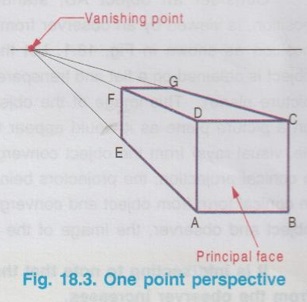
TYPES OF PERSPECTIVE PROJECTION Perspective projections are mainly classified into three categories based on the relative position of the object with respect to the picture plane as below: 1. One point perspective (or Parallel perspective) 2. Two point perspective (or Angular perspective) 3. Three point perspective (or Oblique perspective) If the principal face of the object viewed is parallel to the picture plane, the perspective view formed is called "Parallel perspective" or One point perspective. In one point perspective all the horizontal lines receding the object (ie. AE, DF, CG in Fig. 18.3) converge to a single point called vanishing point. But the vertical and horizontal lines on the principal face and parallel to the picture plane (ie. AD, DC, CB, AB etc.) do not converge. This type of perspective view is generally used for roads, rail road, or such objects which are viewed directly from the front. One point perspective is also used to show the interior details of rooms, interior features of various components etc. If the two principal faces of the object viewed are inclined to the picture plane, the perspective view formed is called "Angular perspective" or Two point perspective. In two point perspective, all the horizontal lines (AE, BF, CG, AD, BC, FG in Fig.18.4) converge to two different points called vanishing point left (VPL) and Vanishing Point Right (VPR). But the vertical lines (AB, DC etc.,) remain vertical. This type of perspective view is generally used to represent the pictorial views of long side and wide objects like buildings, structures etc. If all the three mutually perpendicular faces of the object viewed are inclined to the picture plane, the perspective view formed is called "Obligue perspective" or Three point perspective. In three point perspective, all the horizontal lines (FG, BC, AD, AE, CG etc.) converge to two different points called Vanishing Point Left (VPL) and Vanishing Point Right (VPR) and all the vertical lines (DC, AB, EF in Fig. 18.5.) converge to a third vanishing point located either above (or) below the horizon line. Three point perspective is generally used to draw pictorial views of huge and tall objects like tall buildings, towers, structures etc.1. One point perspective (or Parallel perspective)
2. Two point perspective (or Angular perspective)

3. Three point perspective (or Oblique perspective)

Engineering Graphics: Unit V (b): Perspective Projection : Tag: : Perspective Projection - Engineering Graphics - Types of Perspective Projection
Engineering Graphics: Unit V (b): Perspective Projection
Under Subject
Engineering Graphics
GE3251 eg 2nd semester | 2021 Regulation | 2nd Semester Common to all Dept 2021 Regulation
Engineering Drawing
ME25C01 EEE, Mech, Agri, EEE Depts | 2025 Regulation | 1st, 2nd Semester 2025 Regulation
Related Subjects
Professional English II
HS3251 2nd Semester 2021 Regulation | 2nd Semester Common to all Dept 2021 Regulation
Statistics and Numerical Methods
MA3251 2nd Semester 2021 Regulation M2 Engineering Mathematics 2 | 2nd Semester Common to all Dept 2021 Regulation
Engineering Graphics
GE3251 eg 2nd semester | 2021 Regulation | 2nd Semester Common to all Dept 2021 Regulation
Physics for Electrical Engineering
PH3202 2nd Semester 2021 Regulation | 2nd Semester EEE Dept 2021 Regulation
Basic Civil and Mechanical Engineering
BE3255 2nd Semester 2021 Regulation | 2nd Semester EEE Dept 2021 Regulation
Electric Circuit Analysis
EE3251 2nd Semester 2021 Regulation | 2nd Semester EEE Dept 2021 Regulation
Physics for Electronics Engineering
PH3254 - Physics II - 2nd Semester - ECE Department - 2021 Regulation | 2nd Semester ECE Dept 2021 Regulation
Electrical and Instrumentation Engineering
BE3254 - 2nd Semester - ECE Dept - 2021 Regulation | 2nd Semester ECE Dept 2021 Regulation
Circuit Analysis
EC3251 - 2nd Semester - ECE Dept - 2021 Regulation | 2nd Semester ECE Dept 2021 Regulation
Materials Science
PH3251 2nd semester Mechanical Dept | 2021 Regulation | 2nd Semester Mechanical Dept 2021 Regulation
Basic Electrical and Electronics Engineering
BE3251 2nd semester Mechanical Dept | 2021 Regulation | 2nd Semester Mechanical Dept 2021 Regulation
Physics for Civil Engineering
PH3201 2021 Regulation | 2nd Semester Civil Dept 2021 Regulation
Basic Electrical, Electronics and Instrumentation Engineering
BE3252 2021 Regulation | 2nd Semester Civil Dept 2021 Regulation
Physics for Information Science
PH3256 2nd Semester CSE Dept | 2021 Regulation | 2nd Semester CSE Dept 2021 Regulation
Basic Electrical and Electronics Engineering
BE3251 2nd Semester CSE Dept 2021 | Regulation | 2nd Semester CSE Dept 2021 Regulation
Programming in C
CS3251 2nd Semester CSE Dept 2021 | Regulation | 2nd Semester CSE Dept 2021 Regulation