Engineering Mechanics: Unit III: Distributed Forces
Solved Example & Practice Problems: Pappus-Guldinus Theorems
surface areas, volumes of bodies of revolution
Solved Example Problems, Examples for Practice: Pappus-Guldinus Theorems - Centroid - Distributed Forces - Engineering Mechanics. Pappus-Guldinus Theorem used to find the surface areas of surfaces of revolution and volumes of bodies of revolution
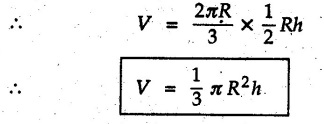
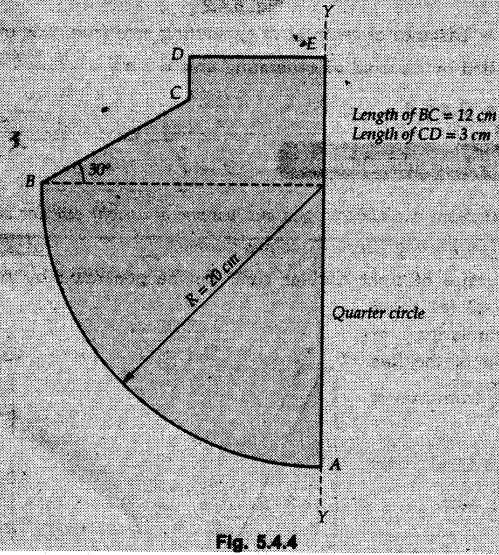
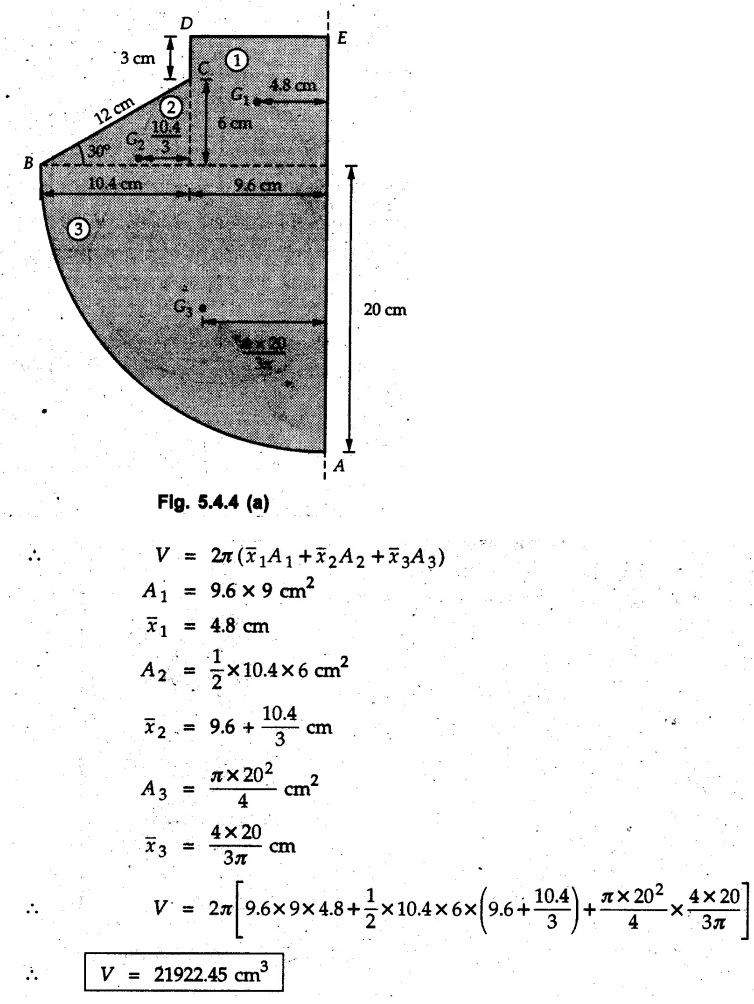
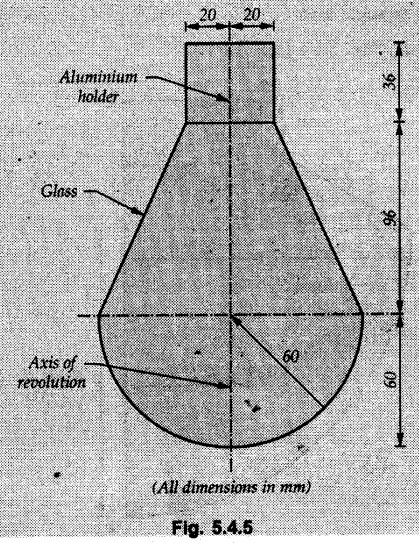
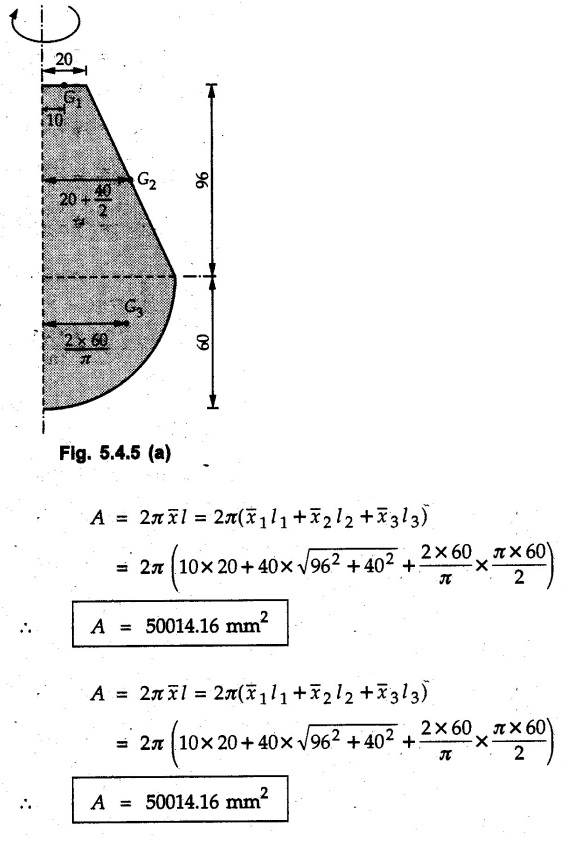
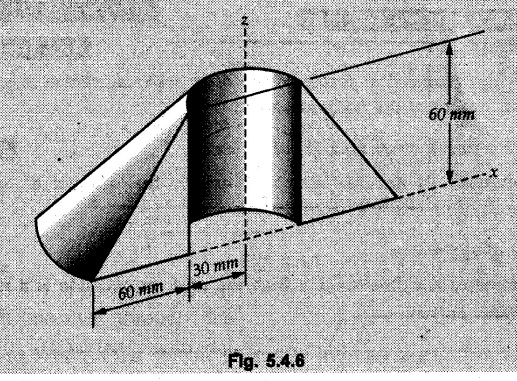
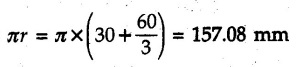
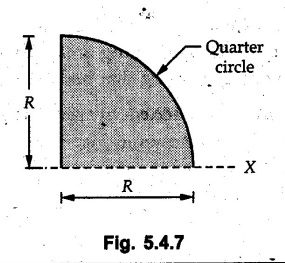
Solved Examples for Understanding Example 5.4.1 Determine the surfaces area and volume of a right circular cone with radius of base R and height h using Pappus-Guldinus theorems. Solution: The surface of right circular cone can be generated by revolving a line as shown in Fig. 5.4.3 (a) about Y-axis. By similarity of triangles, centroid of the line is at a distance R/2 from axis of rotation. Distance travelled by The volume of cone is generated by revolving a triangle as shown in Fig. 5.4.3 (b) about Y-axis. Distance travelled by centroid = 2л R/3 Area of triangle = 1/2 Rh Example 5.4.2 Determine volume of revolution generated by revolving plane lamina ABCDEA shown in Fig. 5.4.4 about Y-Y axis, to 2л rad. Write statement of theorem used for calculating volume. Solution: According to Pappus-Guldinus theorem, the volume of body of revolution is product of the generating area and the distance travelled by centroid of the generating area while generating that body. (Here distance of centroid from Y-axis is The given area can be divided into 3 parts – 1) A rectangle 2) A triangle and 3) A quarter circle (Refer Fig. 5.4.4 (a)) Example 5.4.3 Find surface area of the glass to manufacture an electric bulb shown in Fig. 5.4.5 using first theorem of Pappus-Guldinus. Solution: As surface area of only glass is required, we do not consider the aluminium holder. The glass surface can be generated by revolving the curve shown in Fig. 5.4.5 (a)) about the vertical axis. Example 5.4.4 Calculate the volume V of the solid Fig. 5.4.6 generated by revolving the 60 mm right triangular area through 180° about the z-axis. Solution: By Pappus - Guldinus theorem, V = Generating area × Distance travelled by centroid of generating area Generating area = 1/2 × 60 × 60 = 1800 mm2 Distance travelled by centroid of generating area = ⸫ V = 1800 × 157.08 Examples for Practice Q.1 Find the surface area and volume of a sphere using Pappus-Guldinus theorems. [Ans.: 4лR2, 4/3 πR3] Q.2 The curve shown in Fig. 5.4.7 is rotated about X-axis. Find the area of the surface of revolution. [Ans. : 3π R2]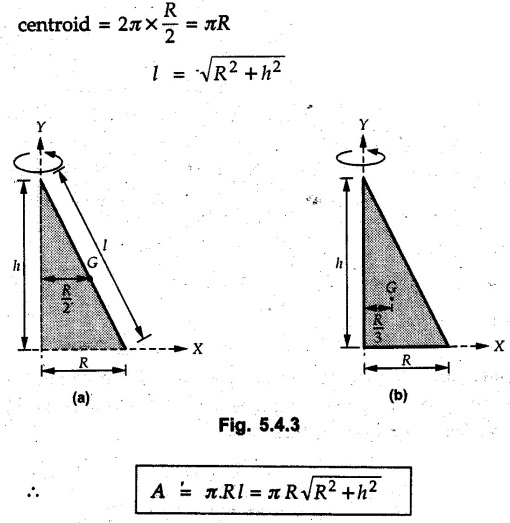

 )
)

Engineering Mechanics: Unit III: Distributed Forces : Tag: : surface areas, volumes of bodies of revolution - Solved Example & Practice Problems: Pappus-Guldinus Theorems
Engineering Mechanics: Unit III: Distributed Forces
Under Subject

Engineering Mechanics
ME3351 3rd semester civil, Mechanical Dept | 2021 Regulation | 3rd Semester Mechanical Dept 2021 Regulation
Related Subjects
Transforms and Partial Differential Equations
MA3351 3rd semester civil, Mechanical Dept | 2021 Regulation | 3rd Semester Mechanical Dept 2021 Regulation
Engineering Mechanics
ME3351 3rd semester civil, Mechanical Dept | 2021 Regulation | 3rd Semester Mechanical Dept 2021 Regulation
Engineering Thermodynamics
ME3391 3rd semester Mechanical Dept | 2021 Regulation | 3rd Semester Mechanical Dept 2021 Regulation
Fluid Mechanics and Machinery
CE3391 3rd semester Mechanical Dept | 2021 Regulation | 3rd Semester Mechanical Dept 2021 Regulation
Engineering Materials and Metallurgy
ME3392 3rd semester Mechanical Dept | 2021 Regulation | 3rd Semester Mechanical Dept 2021 Regulation
Manufacturing Processes
ME3393 3rd semester Mechanical Dept | 2021 Regulation | 3rd Semester Mechanical Dept 2021 Regulation