Engineering Materials and Metallurgy: Unit II: Heat Treatment
Flame Hardening
Meaning, Principle, Suitability, Applications, Advantages, Disadvantages | Heat Treatment
Flame hardening is the process of selective hardening with a combustible gas flame as the source of heat for austenitizing.
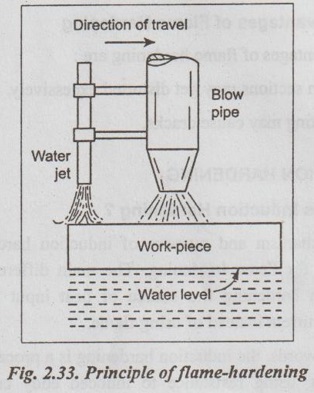
FLAME HARDENING ✓ Flame hardening is the process of selective hardening with a combustible gas flame as the source of heat for austenitizing. ✓ Flame hardening can be performed only on steels with a sufficiently high carbon content - at least 0.4% C (to allow hardening). The surface to be hardened is heated to a temperature above its upper critical temperature, by means of a travelling oxy-acetylene torch, as shown in Fig.2.33. Then it is immediately quenched by a jet of water issuing from a supply built into the torch-assembly. Thus, the surface hardening results when the austenitized surface is quenched by the water spray that follows the flame. The flame hardening technique is suitable for the plain carbon steels with carbon contents ranging from 0.40% to 0.95% and low- alloy steels. It is used to improve wear resistance and surface hardness of teeth of gears, wheels, sheaves, bushings, shafts, mill rolls, cams, spindles, hand tools, etc. The advantages of flame hardening are as follows: 1. There is practically no distortion of workpiece because only small section of steel is heated. 2. The process is more efficient and very economical for larger works. 3. As heating rate is high the surface of work remains clean. 4. It is more suitable for small quantities because it is versatile and equipment cost is less. The disadvantages of flame hardening are: 1. Very thin sections may get distorted excessively. 2. Overheating may cause cracks.1. What is Flame Hardening?
2. Principle of Flame Hardening
3. Suitability
4. Applications
5. Advantages of Flame Hardening
6. Disadvantages of Flame Hardening
Engineering Materials and Metallurgy: Unit II: Heat Treatment : Tag: : Meaning, Principle, Suitability, Applications, Advantages, Disadvantages | Heat Treatment - Flame Hardening
Engineering Materials and Metallurgy: Unit II: Heat Treatment
Under Subject
Engineering Materials and Metallurgy
ME3392 3rd semester Mechanical Dept | 2021 Regulation | 3rd Semester Mechanical Dept 2021 Regulation
Metallurgy and Materials Science
ME25C08 3rd Semester MECH Dept | 2025 Regulation | 3rd Semester 2025 Regulation
Related Subjects
Transforms and Partial Differential Equations
MA3351 3rd semester civil, Mechanical Dept | 2021 Regulation | 3rd Semester Mechanical Dept 2021 Regulation
Engineering Mechanics
ME3351 3rd semester civil, Mechanical Dept | 2021 Regulation | 3rd Semester Mechanical Dept 2021 Regulation
Engineering Thermodynamics
ME3391 3rd semester Mechanical Dept | 2021 Regulation | 3rd Semester Mechanical Dept 2021 Regulation
Fluid Mechanics and Machinery
CE3391 3rd semester Mechanical Dept | 2021 Regulation | 3rd Semester Mechanical Dept 2021 Regulation
Engineering Materials and Metallurgy
ME3392 3rd semester Mechanical Dept | 2021 Regulation | 3rd Semester Mechanical Dept 2021 Regulation
Manufacturing Processes
ME3393 3rd semester Mechanical Dept | 2021 Regulation | 3rd Semester Mechanical Dept 2021 Regulation