Engineering Mechanics: Unit IV: Friction
Dry Friction and Coefficients of Friction
Suppose a block of weight 'W' is kept on a rough horizontal surface and a horizontal force 'P' is applied to it as shown in Fig. 8.2.1.
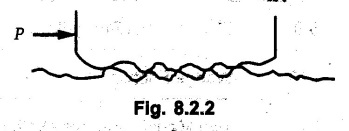
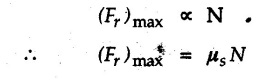
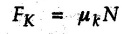
Dry Friction and Coefficients of Friction • Suppose a block of weight 'W' is kept on a rough horizontal surface and a horizontal force 'P' is applied to it as shown in Fig. 8.2.1. • When force 'P' is small, the block does not move. • This is because of the frictional force which balances P. • The frictional force is largely due to interlocking of irregularities in the two surfaces in contact as shown in Fig. 8.2.2. • The frictional force is also, to a small extent, due to the molecular forces of attraction between the two surfaces in contact. • If force P is increased, friction force Fr increases and remains equal to P as long as the object is static. • When P is increased beyond a certain value (Fr)max, the object starts moving, the frictional force decreases and then remains nearly constant. • This variation in magnitude of frictional force with the applied force P is shown in Fig. 8.2.3. • From the above discussion, we conclude the following points which are important while solving. problems: 1) As long as object is static, the frictional force has same magnitude as the net force trying to move the object and has opposite direction. 2) Motion impends when net force trying to move the object becomes equal to the maximum frictional force (F) max known as the limiting static friction force. 3) When object starts moving, the frictional force is constant, independent of the net applied force. • Experimental evidence shows that the maximum value of frictional force (the limiting static friction force) is proportional to the normal component of reaction N. i.e., Where μs is a constant known as coefficient of static friction. • Similarly, the magnitude of the kinetic friction force is expressed as Where μk is a constant known as coefficient of kinetic friction. • The coefficients μs and μk do not depend on the surface area in contact but depend on the nature of the surfaces in contact.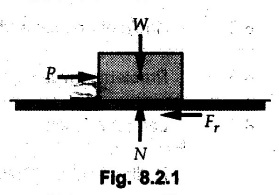

Engineering Mechanics: Unit IV: Friction : Tag: : - Dry Friction and Coefficients of Friction
Engineering Mechanics: Unit IV: Friction
Under Subject

Engineering Mechanics
ME3351 3rd semester civil, Mechanical Dept | 2021 Regulation | 3rd Semester Mechanical Dept 2021 Regulation
Related Subjects

Transforms and Partial Differential Equations
MA3351 3rd semester civil, Mechanical Dept | 2021 Regulation | 3rd Semester Mechanical Dept 2021 Regulation
Engineering Mechanics
ME3351 3rd semester civil, Mechanical Dept | 2021 Regulation | 3rd Semester Mechanical Dept 2021 Regulation

Engineering Thermodynamics
ME3391 3rd semester Mechanical Dept | 2021 Regulation | 3rd Semester Mechanical Dept 2021 Regulation

Fluid Mechanics and Machinery
CE3391 3rd semester Mechanical Dept | 2021 Regulation | 3rd Semester Mechanical Dept 2021 Regulation

Engineering Materials and Metallurgy
ME3392 3rd semester Mechanical Dept | 2021 Regulation | 3rd Semester Mechanical Dept 2021 Regulation

Manufacturing Processes
ME3393 3rd semester Mechanical Dept | 2021 Regulation | 3rd Semester Mechanical Dept 2021 Regulation