Engineering Materials and Metallurgy: Unit IV: Non-Metallic Materials
ceramics
Characteristics, Classification
The word 'ceramic' derives from the Greek 'keramos', which means "burnt stuff" or pottery. In earlier times, ceramic embraces only.
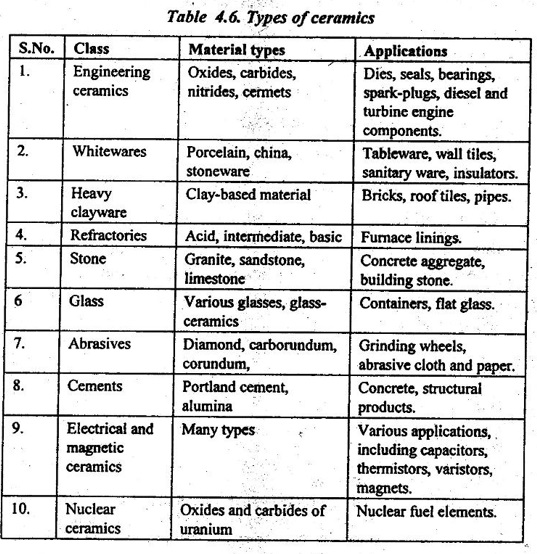
ENGINEERING CERAMICS CERAMICS The word 'ceramic' derives from the Greek 'keramos', which means "burnt stuff" or pottery. In earlier times, ceramic embraces only. earthenware, pottery and porcelain materials. House bricks, earthen ware pots and porcelain cups are everyday examples of the use of these traditional ceramic materials. However, today the word ceramic is applied to a much wider range of materials than those used to make these common items. In general, ceramics are all man-made non- metallic and inorganic solids. Thus the term ceramic embraces not only earthenware, pottery and porcelain, all materials used by man from earliest times, but also the newer engineering ceramics which are mainly the oxides, carbides and nitrides of metals. In addition to 'traditional' applications (such as making bricks, tiles, potteries, cooking wares, cements, concretes, refractories, etc.),. ceramic materials are used in varied engineering applications, including tools for grinding and cutting, seals, bearings, magnets, other components for engines and pumps, tiles for the space shuttles, fibres and laser sources for optical communications, and for many applications in the electrical and electronic industries. Therefore it is necessary for the engineers to have knowledge about these engineering ceramics. We shall discuss the important characteristics and typical applica- tions of some engineering ceramics in the following sections. The outstanding features of ceramics are given below: 1. Ceramics are non-metallic and inorganic solids that are pro- cessed and/or used at high temperatures. 2. Ceramics are strong, hard, and brittle. 3. They possess high melting temperature. 4. They are good thermal and electrical insulators. 5. They are resistant to oxidation and corrosion. 6. They have high compressive strength but are weak in tension. Although there are numerous types of ceramic materials available, we can summarise the main groupings of ceramics as shown in Table 4.6. The Table 4.6 also presents the typical materials and their applications for each class. However, our study is limited only to engineering ceramics.1. Introduction
2. Characteristics of Ceramics
3. Classification of Ceramics
Engineering Materials and Metallurgy: Unit IV: Non-Metallic Materials : Tag: : Characteristics, Classification - ceramics
Engineering Materials and Metallurgy: Unit IV: Non-Metallic Materials
Under Subject
Engineering Materials and Metallurgy
ME3392 3rd semester Mechanical Dept | 2021 Regulation | 3rd Semester Mechanical Dept 2021 Regulation
Metallurgy and Materials Science
ME25C08 3rd Semester MECH Dept | 2025 Regulation | 3rd Semester 2025 Regulation
Related Subjects
Transforms and Partial Differential Equations
MA3351 3rd semester civil, Mechanical Dept | 2021 Regulation | 3rd Semester Mechanical Dept 2021 Regulation
Engineering Mechanics
ME3351 3rd semester civil, Mechanical Dept | 2021 Regulation | 3rd Semester Mechanical Dept 2021 Regulation
Engineering Thermodynamics
ME3391 3rd semester Mechanical Dept | 2021 Regulation | 3rd Semester Mechanical Dept 2021 Regulation
Fluid Mechanics and Machinery
CE3391 3rd semester Mechanical Dept | 2021 Regulation | 3rd Semester Mechanical Dept 2021 Regulation
Engineering Materials and Metallurgy
ME3392 3rd semester Mechanical Dept | 2021 Regulation | 3rd Semester Mechanical Dept 2021 Regulation
Manufacturing Processes
ME3393 3rd semester Mechanical Dept | 2021 Regulation | 3rd Semester Mechanical Dept 2021 Regulation